
Spending a day at an Italian beach is about much more than swimming and sunbathing. It’s a ritual that marks the arrival of summer and reveals a surprising amount about Italian culture. From beach clubs to free beaches, from long seafood lunches to unforgettable beach characters, here’s what to expect before you spread your towel on the sand.

Italians have an ancestral bond with the sea. It’s as if their instincts, especially after the winter lethargy, drag them to the many beaches of the peninsula to fill up on vitamin D and, as I once heard a lady say, “fare il pieno di vita“—fill up on life.
We start timidly, with a pranzo al mare, a lunch at the beach in the company of a partner or friends. The joy of that first plate of spaghetti alle vongole, a generous frittura mista, an ice-cold glass of Vermentino, and a refreshing sorbetto al limone reminds you what summer is really about.
Then come the days warm enough to organize a full day at the beach: swimming, sunbathing, chatting, reading a book, occasionally hiding under the shade of a beach umbrella, and doing as little as possible.
This article has a soundtrack
Before you continue reading, press play on Luca Carboni’s Mare Mare. Like many Italians, this article belongs by the sea.
What Makes an Italian Beach Different?
Some, because of personal preference—or their wallet’s “preferences”—choose the spiaggia libera, the public beach. They arrive equipped with an entire survival kit: umbrellas or pareos ingeniously tied to branches to create makeshift shelters, oversized thermal bags filled with frozen bottles of water, beers, and homemade insalata di riso or insalata di pasta, lovingly prepared at home or bought from the neighbourhood deli.
Others spend the day at a stabilimento balneare. Although often translated as “beach club,” the Italian stabilimento is usually much more down-to-earth than the expression suggests. Especially around Rome, it’s a wonderfully ordinary place made of rows of umbrellas, plastic sunbeds, loud bars, sandy feet, card games, seafood lunches and generations of the same families returning every summer.
And then there are the people.
Every Italian beach becomes a small theatre populated by recurring characters. You will meet them everywhere, from Liguria to Sicily. Once you learn to recognize them, you’ll never stop noticing them.

The Hippie
Here we find the first archetype of the Italian beach: the Hippie.
He or she is often accompanied by a dog with dreadlocks, wears wide Turkish trousers, Birkenstock sandals, a soft oversized T-shirt or tank top, and long wooden necklaces. They are deeply tanned, completely unafraid of the sun, the salt, or disappearing into the pineta or the dunes whenever nature calls.
The Lizard
They share their disregard for sun damage with the Lucertola—the Lizard.
Women (and men) who, once they reach their towel or strategically positioned sunbed, only get up when it’s finally time to leave, when the sun has completely exhausted its bronzing powers.
They don’t pee.
I don’t know their secret.

Narciso
They don’t show signs of life—not even when the annoying Narciso, our next archetype, starts a phone conversation so loud that everyone learns his grandmother is about to undergo hip surgery and his best friend has been caught cheating.
They are usually impressively toned after a year of gruelling gym sessions and, admittedly, rather pleasant to look at—if only someone could activate silent mode.
A few tanning-bed sessions before summer are almost always part of the preparation.
The Putti
Wild, abandoned children straight out of Neverland are the beach Putti.
Their parents are at the bar having a drink with friends or endlessly scrolling on their phones while the children freely explore the surroundings and invade everyone else’s personal space.
Once, I watched one of these little cherubs pee on my friend’s towel while he was peacefully sunbathing with his eyes closed.
It was hilarious.
For us.

The Girl at the Bar
Seasonal workers become the hosts of those lucky enough to spend the day in a stabilimento.
The Girl at the Bar—a humble but perfectly functional wooden cabin built directly on the sand—is, for reasons I have never fully understood, almost always smiling, slightly chubby and wonderfully loud.
The Bagnino
The bagnino, the lifeguard, is usually much quieter.
Especially around lunchtime.
The moment the restaurant sends him a gigantic plate of fried seafood, the aroma unknowingly becomes the establishment’s most effective marketing strategy.
Within minutes, everyone suddenly feels hungry.

The Vucumprà
With the utmost respect, let me introduce you to the Vucumprà.
Usually African immigrants, they walk from towel to towel carrying entire collections of fake designer bags, sunglasses, wallets, pareos and colourful bead necklaces.
The nickname originated in the 1980s from the compressed phrase “vuoi comprare?” (“Do you want to buy?”), which gradually became vucumprà.
Perhaps I’m naïve, but I’ve always found both the word and the long conversations that often follow to represent a very Italian form of integration.
I might be a bit naïve, but I’ve always found the name, just like the long shopping and chatting sessions hosted by the beach “Queen Bees” in their little microcosm—made of two sunbeds (the husband evicted from his own and kindly offered to the seller), a side table, and a front-row umbrella by the water—to represent a very Italian form of integration.
Not regulated.
Not imposed.
But direct: you sell, I buy, and in the meantime, we get to know each other’s lives, without having to invent a story around the naked truth.
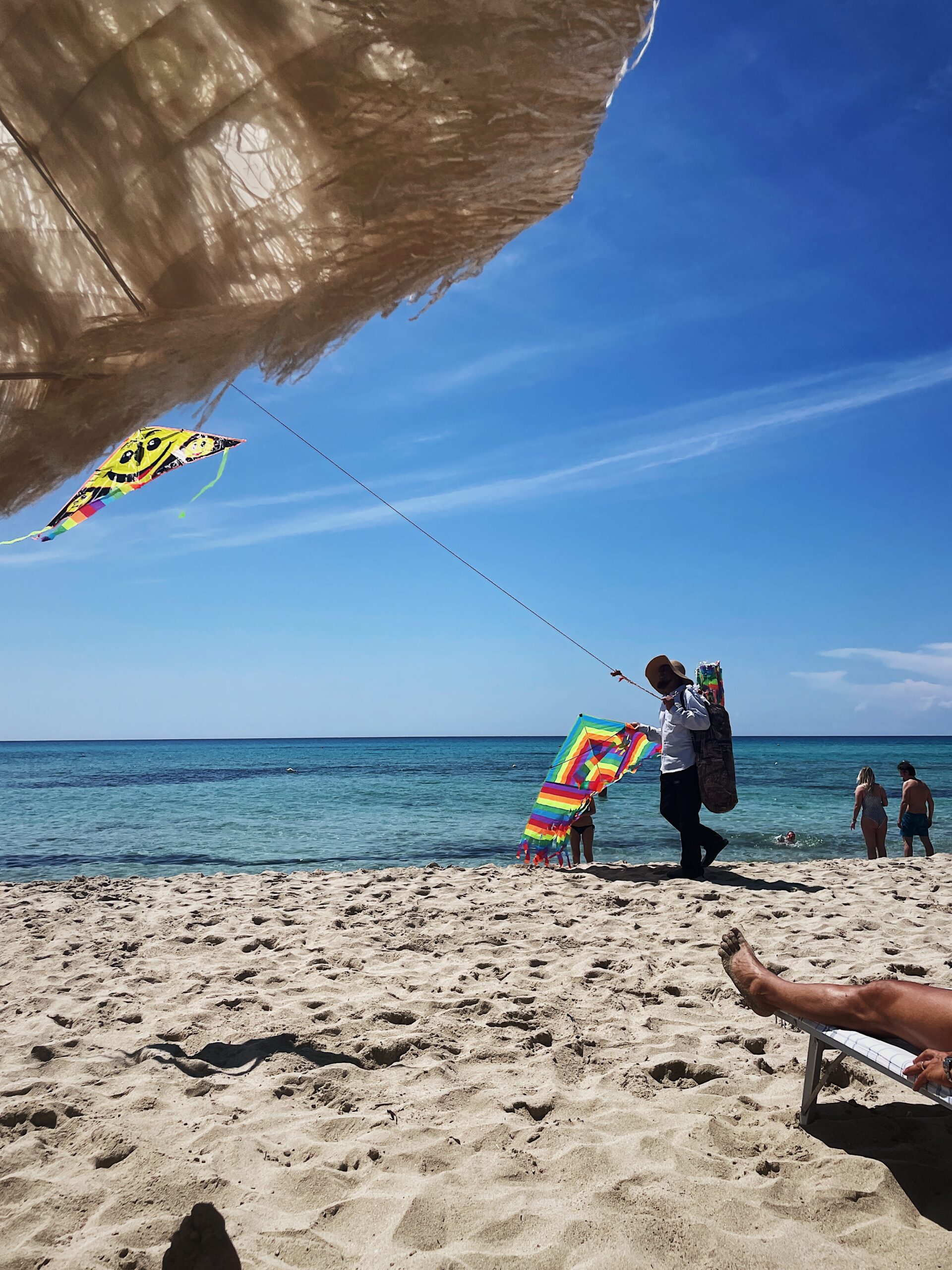
Teenagers
Adolescenti, teenagers, are the final archetype on this admittedly incomplete list.
Girls move in packs.
They travel together from the bar to buy gelato, back to the beach, then to impromptu volleyball matches using the lightweight plastic balls purchased from the Vucumprà.
After swimming, they always—always—run to the showers because they can’t stand the feeling of salt drying on their skin.
They carry giant beach bags full of sunscreen and mysterious tubes of after-sun remedies.
They’re adorable.
Teenage boys, on the other hand, spend hours playing football on the bagnasciuga—a wonderful Italian word that literally combines “wet” and “dry.”
They stop only to devour a panino, drink a Coke, or retrieve the ball after someone inevitably kicks it too far away.

Why the Italian Beach Is About More Than the Sea
From late May until early September, the Italian beach becomes a small, noisy ecosystem where every kind of person coexists in spaces that somehow always feel too small.
It mirrors Italian city life—but with cleaner air, fewer clothes and a much more relaxed rhythm.
Well… most of the time.
Arguments still erupt when a football lands in Queen Bee territory, Narciso’s performance is interrupted, or a dog—or a Putto—chooses the wrong towel as a bathroom.
But perhaps that’s exactly the point.
The Italian beach isn’t simply a place where people go swimming.
It’s where Italy, in all its beautiful chaos, goes on holiday.
Inside Italian Culture
If you’re planning a trip to Italy (or dreaming of, or living here!), understanding places like these before you arrive changes the way you’ll experience them.
That’s exactly why I created in Inside Italian Culture: a series of personal conversations designed to help you discover the Italy that guidebooks rarely explain.
Enjoy life on an Italian beach!
Claudia