
On November 2, All Souls’ Day, Rome remembers those who drowned in the Tiber with the Sacconi Rossi procession on the Isola Tiberina. The name comes from the red robes of a confraternity whose members recovered bodies from the river and gave them a burial. Today, its legacy continues with a Mass, a procession, and a wreath cast into the water.

Waiting on the Isola Tiberina
I’m here, leaning against a wall. On the Isola Tiberina. In the middle of the Tiber River.
I’m waiting to witness something special.
I’ve already taken a few pictures of the church, its doors open for the occasion.

The only Italians I see are inside the church, preparing for the rite.
The rest are foreigners who seem to appreciate our culture more than we locals do.
There are a couple of tourist guides with groups of people intensely focused on their accounts. You can feel their thirst for knowledge. The emotion you experience only when you’re a visitor. One group is American, I’m sure. I heard them talking of Boston. The French are easy to identify, even at a distance. The pretty ladies next to me, leaning against the wall, might be Portuguese.
A few Italians join us minutes later; they seem to be relatives of the confreres. Are they the only ones aware of the existence of this rite? What would happen if the few who preserve the traditions went extinct, I ask myself. I must ask my friends if they know about it. I send them a pic and the question, and wait for their reaction. No, they don’t.
The superpower I’d ask for at this very moment is being able to reeducate myself and my compatriots.
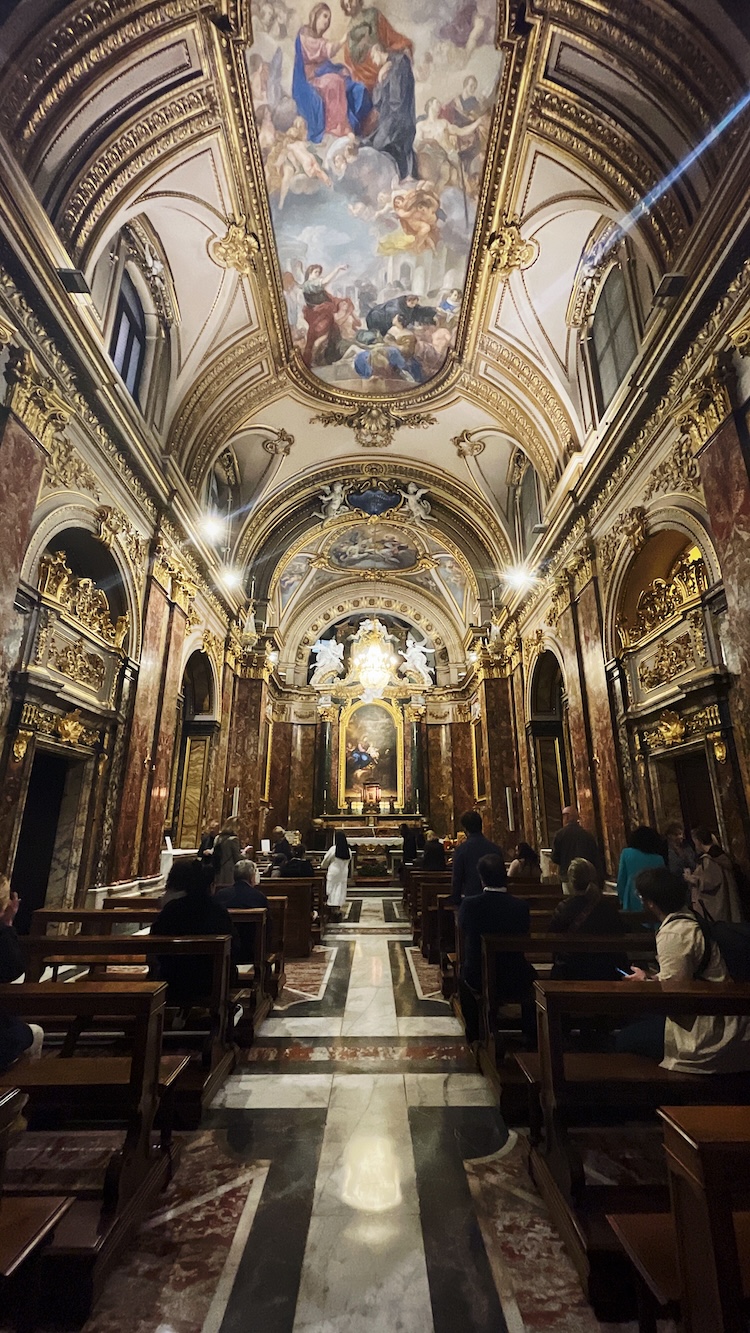
I arrived pretty early. I witnessed all the preparations.
A big white van unloaded many white plastic boxes. I have no idea what they contained. The red capes? The flowers? Food for refueling afterward?

The day is perfect: Fall leaves, cloudy and windy.
On my walk along the Lungotevere to reach the island, the scene was precious, framed by the browning and vintage-matte gold leaves dancing on the trees. They gave it a delicately creepy aura. The river’s waters flowed vigorously, gifting me a deeper understanding of why this tradition was born.

The more I wait, the more the dim light emphasizes the shades. If you are in Rome in the Fall, endow yourself with this evanescent moment of beauty.

Before the Sacconi Rossi Procession
I just peered inside the church and saw the first red-hooded person. For no rational reason, I was expecting the robe to be old and threadbare. It was instead bright and very well kept. I told myself it might be a newbie.
I’m not a religious person, but I consider myself spiritual. And by spiritual, I mean I value traditions, rites, and history and the impact they have on my soul. Together with art, they make life worth living. And I know this echoes a quote from Dead Poets Society, but it is one of the truths I’ve learned growing up (old).

I took another peek inside the church. It is now full of people seated on the benches, waiting. I am still wondering what’s coming next. A benediction sounds plausible.

The last time I was on the island, it was for a medical examination inside the hospital in front of me. The only consolation of the experience was the view from the little window and sharing the amazement with the doctor.

A mega panel on the other side of the street alternates colored lights: it’s advertising a product or a movie. I can’t and don’t want to decipher it. I just want to grump at its oddness.
Will they be on time, or will they do it Roman style?
I walk once again to the church. A short, soft-voiced lady with an armband saying “staff” is telling the Portuguese ladies that there will be a brief Mass, and they’ll be out by six.
We all wait until six thirty.
Flowers for the Dead in the Tiber
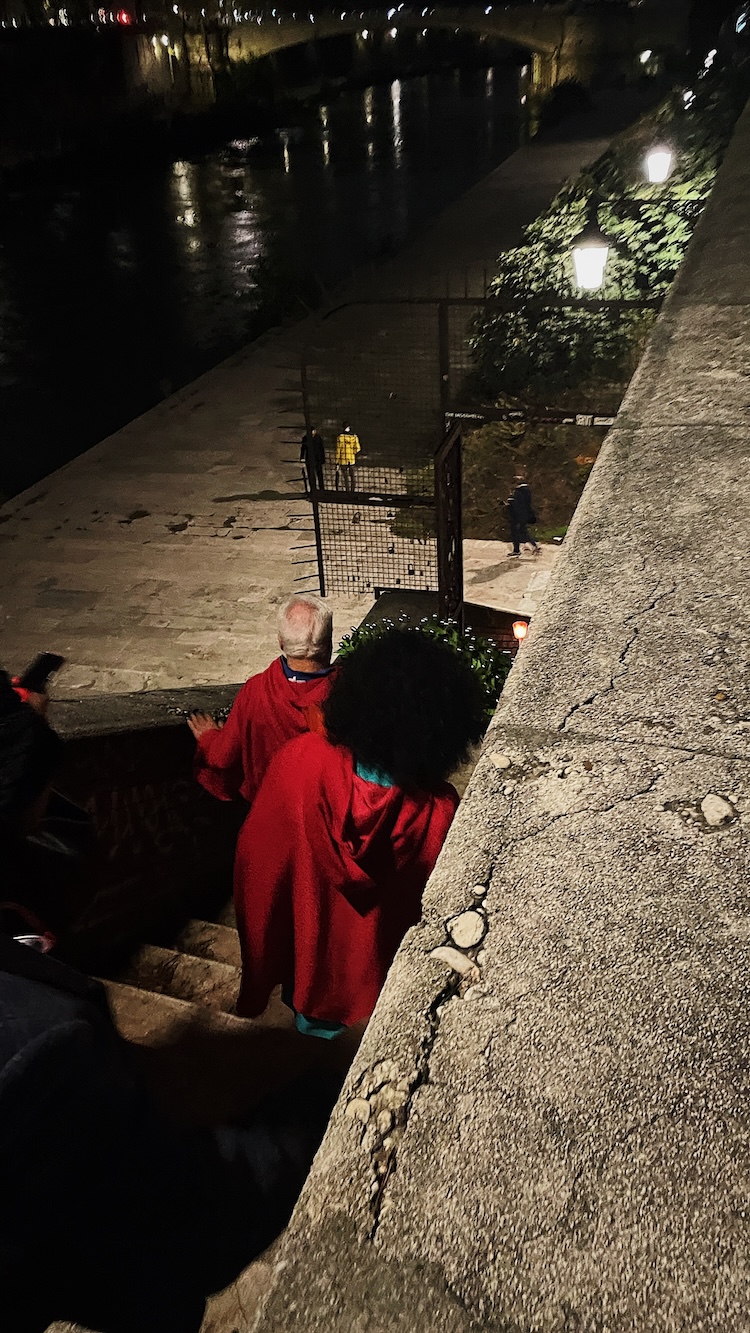
I decide to change location and wait atop the stairs descending to the riverbanks.
I take a few pics, I observe the river flow. It’s gone from muddy brown to almost black, but still foamy, more ominous.
Then I see the first lights, spotted between the cars parked all around: there’s no solemnity gained by popularity. Only believers.
The first are red-robed, silent, smiling with what I perceive as embarrassment. A cross in the hands of the person in the lead. Candles. Not all the red comes from robes: some are capes. Then come the civilians. Then the nuns. And they are singing. A priest follows, adding masculine tones to the notes. They should all sing, I consider.
There are no bodies to be collected but flowers to be thrown.
I walk away. I want to see the rest from a distance. From the bridge. I want to see these tiny people, this tiny aggregation on the island, giant in comparison. From down there, they are doing what only a few enlightened people do: preserving what makes us unique, our heritage.
From the taxi on my way back home, I suddenly hear, one after the other, the bells of the churches we cross ring to commemorate the dead.
Till then, I hadn’t thought of my dearly departed. And I don’t want to, but the bells insist…
This article first appeared in my Italian Colors Sunday Letter. Subscribe if you like Italian tidbits!
If, instead, you want to dive deeper into the Tiber and meet a couple of ghosts and spirits from the past, take a look at Papal Rome’s Simposio, my book about papal kitchens, osterie, and Roman food.
Claudia