
In Rome, pizza bianca is not really considered pizza.
It’s breakfast, merenda, beach food, emergency lunch, and sometimes dinner eaten standing in the kitchen.
If you’ve ever walked through Rome holding a warm slice wrapped in brown paper already turning translucent from the grease, you know exactly what I mean.
And if you’ve never completed the experience with a few slices of mortadella, preferably while standing somewhere between a bakery and a Roman alleyway, then there is still an important chapter missing from your Italian education.
PIZZA BIANCA, ROME, AND A LOT OF GREASE
Usually, when you try to make Pizza Bianca at home, the result ends up very far from that oily, crunchy, slightly salty slice you remember from Rome.
The one with bubbles on the surface, flour on your fingertips, and olive oil practically shining under the light.
But Gabriele Bonci — the Pizza Bianca (and Pizza Rossa) hero of the capital — revealed a few tricks that brought many of us considerably closer to the real thing.
I put together Chef Bonci’s techniques, tips gathered through years of reading and cooking, and a little common sense. The result is a Pizza Bianca Romana recipe that finally tastes like Rome.
HOW ROMANS EAT PIZZA BIANCA
Pizza Bianca, in Rome, is consumed more like bread than pizza.
Romans prefer it hot and stuffed with mortadella (“pizza e mortazza”).
Children dream of it spread with an unreasonable amount of Nutella.
Bars toast it with Emmental cheese and prosciutto cotto.
Some fill it with sautéed scarola or other leafy greens cooked with garlic, olive oil, and chili.
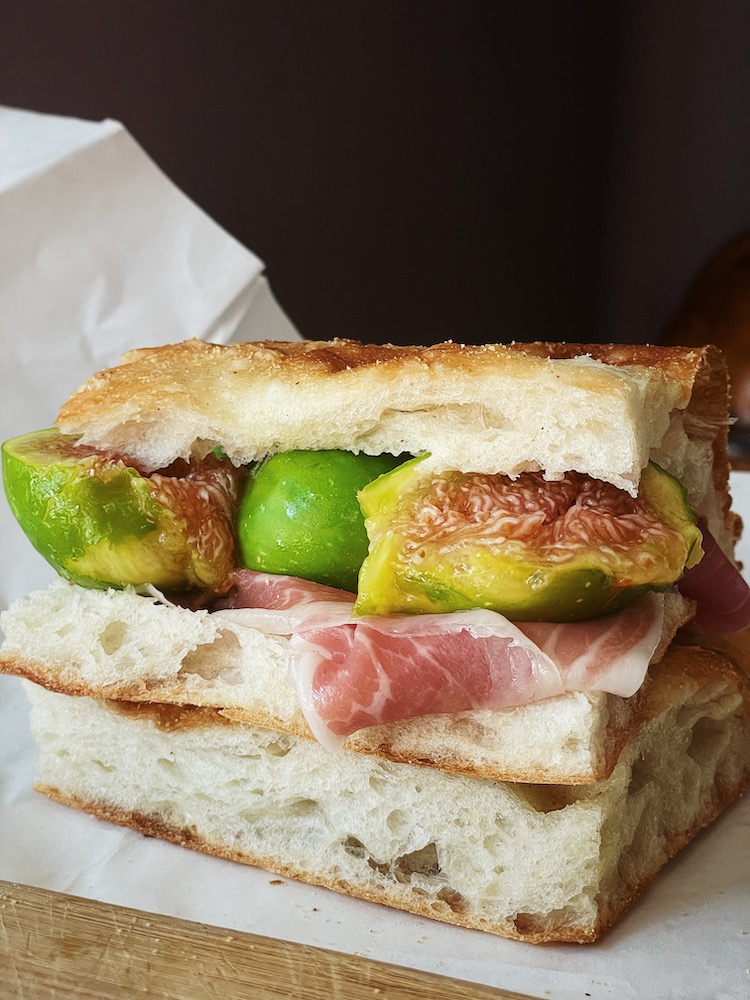
And one of my favorite versions remains the simplest Roman classic: pizza bianca with prosciutto crudo and fresh figs.
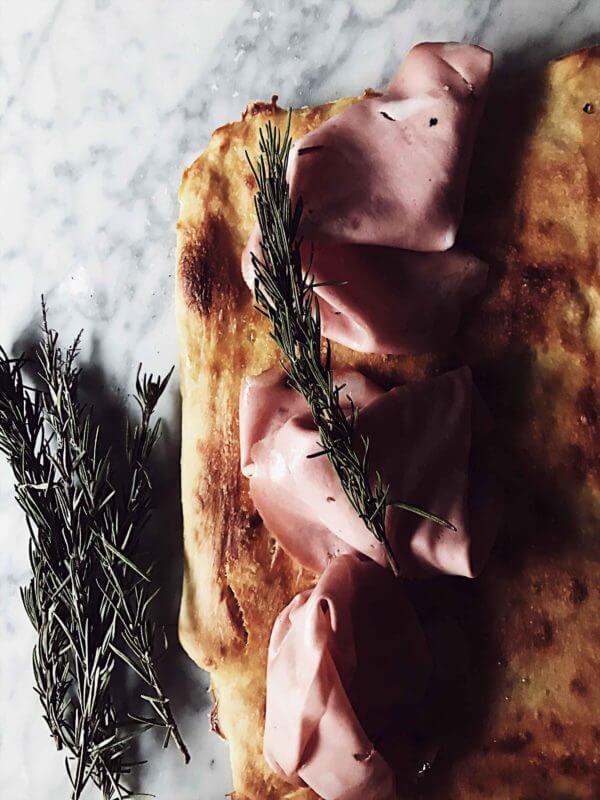
PIZZA E MORTAZZA
If you’ve ever visited Rome, it’s almost impossible you left without devouring at least one slice of Pizza Bianca.
You may or may not have had it accompanied by the city’s institutional filling: mortadella.
If not, pizza e mortazza is your next culinary mission.
Remember:
the pizza must be hot;
the mortadella can be plain or pistachio-studded;
and you can either lay the cold slices on top or open the pizza in half and stuff it sandwich-style.
I add rosemary.
And you should too.
pizza bianca recipe
Ingredients
- 17.6 oz Manitoba flour or very strong Canadian wholemeal flour 500 gr
- 14 oz cold water 400 gr
- 1 teaspoon sea salt 15 gr - 0.5 oz
- 1/4 teaspoon dried yeast 3 gr - 0.1 oz
- 1 tablespoon of extra-virgin olive oil + something more for the bowl and the pizza surface
- a few tablespoons of semolina flour to work the dough
Instructions
-
Dissolve the yeast in 50 gr (1.8 oz) of the water.
-
Place the flour and half of the remaining water in a large bowl. Mix coarsely with a fork (it’s important you use a fork).
-
Add the yeasted water and fork-mix again.
-
Add the oil, salt, and remaining water and continue mixing with the fork.
-
Cover the dough with a damp cloth and let it sit for about 10 minutes in the warmest spot of your house.
-
Pour the dough onto a working surface and fold it over itself: first the outer edges vertically toward the center, then the top edges horizontally toward the center.
-
Grease the bowl lightly with olive oil and return the dough to it, folded side down.
-
Cover with plastic wrap and refrigerate overnight on the lowest shelf, or for at least 12 hours and up to 24.
-
Line an oven tray with parchment paper. I used a perforated baking sheet to let the heat reach the bottom of the pizza properly. The important thing is using a thin tray, not a heavy thick one.
-
Pour the dough onto the baking sheet (help yourself with a spatula) and gently tap it with your fingertips to spread it evenly.
-
Let it rest for at least 2 hours.
-
Sprinkle the surface with olive oil and 1–2 teaspoons coarse salt.
-
Preheat the oven to 250°C (480°F). Use ventilated mode plus bottom heat for the first 10 minutes.
-
Bake the pizza for 10 minutes.
-
Lower the temperature to 220°C (430°F), switch off ventilation, and bake for 10 more minutes.
-
Bubbles will form on the surface — and that’s perfectly fine. The result you are looking for is a deeply golden, spotted surface.
Buon appetito!
Claudia