
The Doge’s Palace in Venice is much more than an extraordinarily beautiful building.
It was the residence of the Doge, the heart of the political and administrative life of the Venetian Republic, a place where government, justice, spectacle, art, and power were constantly intertwined.
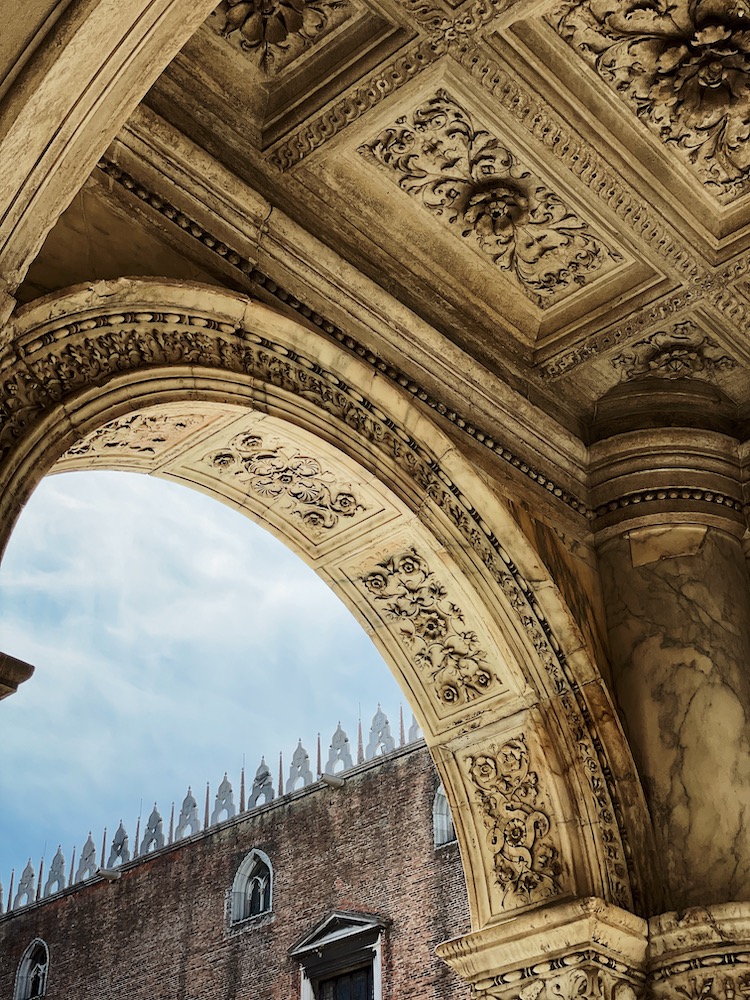
Let me catapult you inside the Doge’s Palace through a photographic tour, adding, here and there, a piece of information.
But before that: who was the Doge?
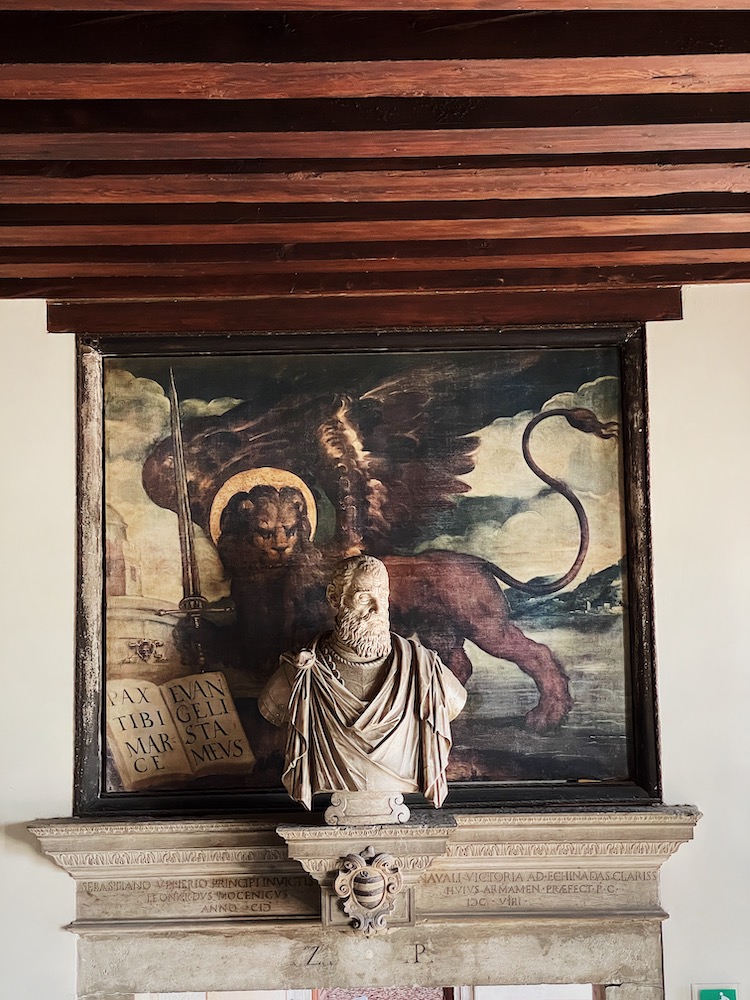
Who Was the Doge of Venice?
The Doge was the oldest and highest magistrate of the Venetian Republic.
He was elected for life and embodied the supreme representation of the State—but, especially as the Republic evolved, his actual powers were remarkably limited. He was surrounded by councillors, bound by strict rules, and did not personally hold executive, legislative, or decision-making power.
And he was elected through one of the most complicated voting mechanisms ever conceived by humankind.
So complicated that a visual representation was needed to remember the various phases.
The Maggior Consiglio, or Great Council, could include between 1,200 and 2,000 Venetian noblemen. The definitive electoral system, established in 1268, alternated selection by lot with voting again and again and again.
Thirty members were chosen by lot.
These were reduced by lot to nine.
The nine elected forty.
The forty were reduced by lot to twelve.
The twelve elected twenty-five.
The twenty-five were reduced by lot to nine.
The nine elected forty-five.
The forty-five were reduced by lot to eleven.
The eleven elected forty-one.
And the final forty-one elected the Doge, who needed at least twenty-five votes.
30 → 9 → 40 → 12 → 25 → 9 → 45 → 11 → 41 → 1.
There were also safeguards against families concentrating influence: members of the same family could not simply accumulate places within the electoral groups.
All this mess was to minimize the possibility of creating factions and concentrating power in a few hands.
But in Italy, there’s a saying:
“Fatta la legge, trovato l’inganno.”
Which translates into something like:
“Passed the law, found the loophole.”
Don’t ask me how, but in Venice, they found a way too.
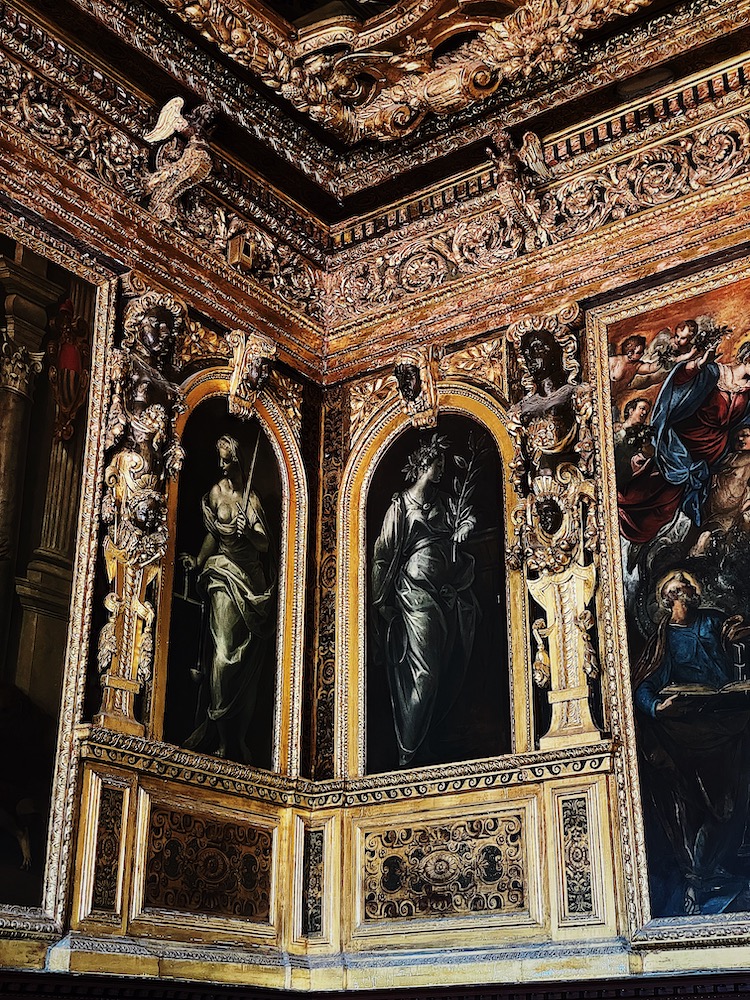

The Doge’s Palace Was a Government Machine
The Palazzo Ducale was the residence of the Doge but also the center of political and administrative life.
The reason why one of the first things we encounter is this mouthed “mailbox” where anonymous denunciations could be dropped.
Quite the mailbox.
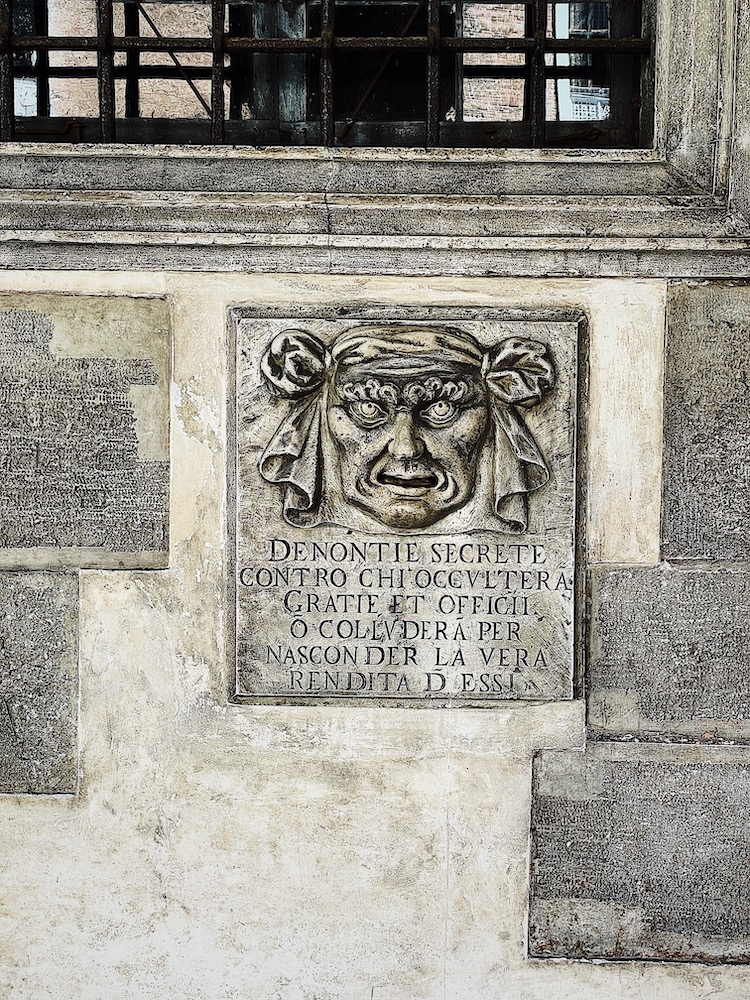
Time worked differently in old Venice, too.
The traditional Venetian—or Italian—system divided the day into twenty-four hours, with the twenty-fourth hour coinciding with sunset and the new day beginning afterwards.
And bells did much more than tell the time: individual bells of St Mark’s summoned the Great Council and the Senate, marked the working day at the Arsenal, and announced other moments of civic and religious life.
Time, politics, denunciations.
Just another day in Venice.
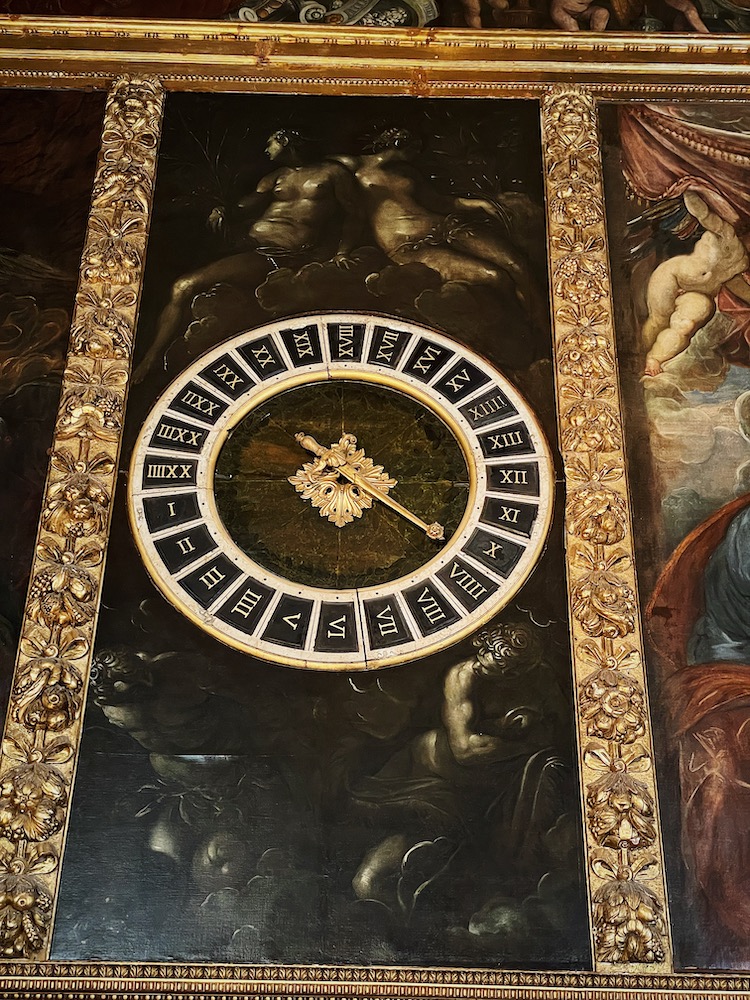
The Council of Ten: Power, Fear, and a Lot of Gold
Then you enter the room of the Consiglio dei Dieci, the Council of Ten.
It had been created after the failed conspiracy of Bajamonte Tiepolo in 1310 as a temporary institution.
Temporary, apparently, in the Venetian sense of the word.
It became permanent and eventually exercised authority over vast areas of public life and State security, acquiring the reputation of a ruthless, secretive tribunal.
The ten members sat together with the Doge and his six councillors.
And above them?
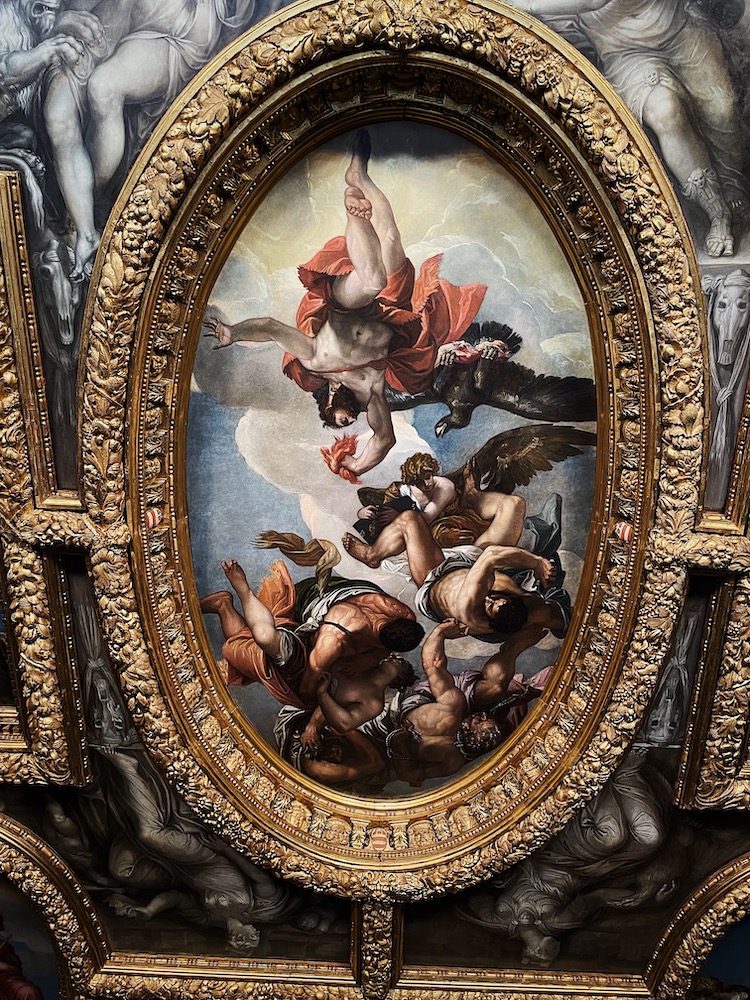
Jupiter fulminates the vices.
Literally.
The central oval in the ceiling shows Jove descending from the clouds and hurling thunderbolts at Vice.
What you see today is actually a copy: Veronese’s original was taken to the Louvre during the Napoleonic period.
Subtle.

Waiting for Justice
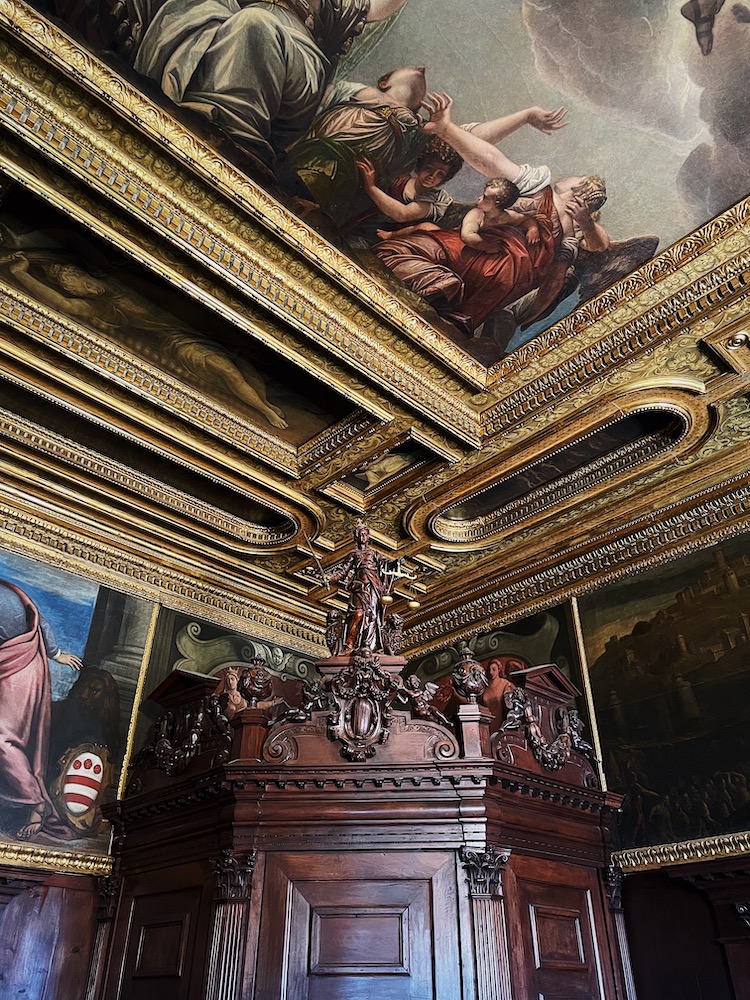
Then comes the Sala della Bussola, the Compass Room.
It was the antechamber for those summoned before the powerful magistrates administering justice.
Its name comes from a large wooden structure—the bussola—surmounted by a statue of Justice.
Imagine waiting for your turn here.
No pressure whatsoever.
And yes, the Lion of Saint Mark is never very far away.
The Room of the Maggior Consiglio
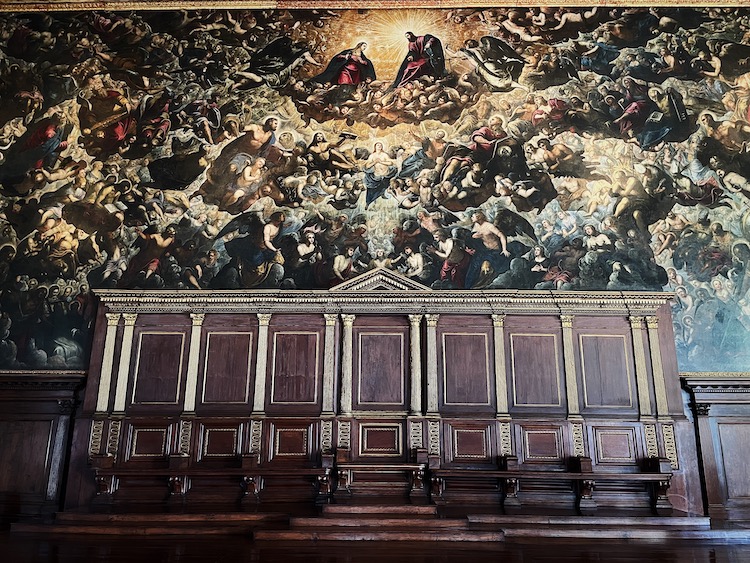
Then there is the room of the Maggior Consiglio.
Fifty-three meters long, twenty-five wide, and one of the largest rooms in Europe.
Here the Great Council met: male members of the Venetian patriciate, eventually numbering as many as 1,200 to 2,000.
This was one of the central institutions of the Republic, and the decorations surrounding them were anything but neutral. They celebrated Venetian history, military achievement, virtues, and the Republic itself.
Political communication, Renaissance edition.
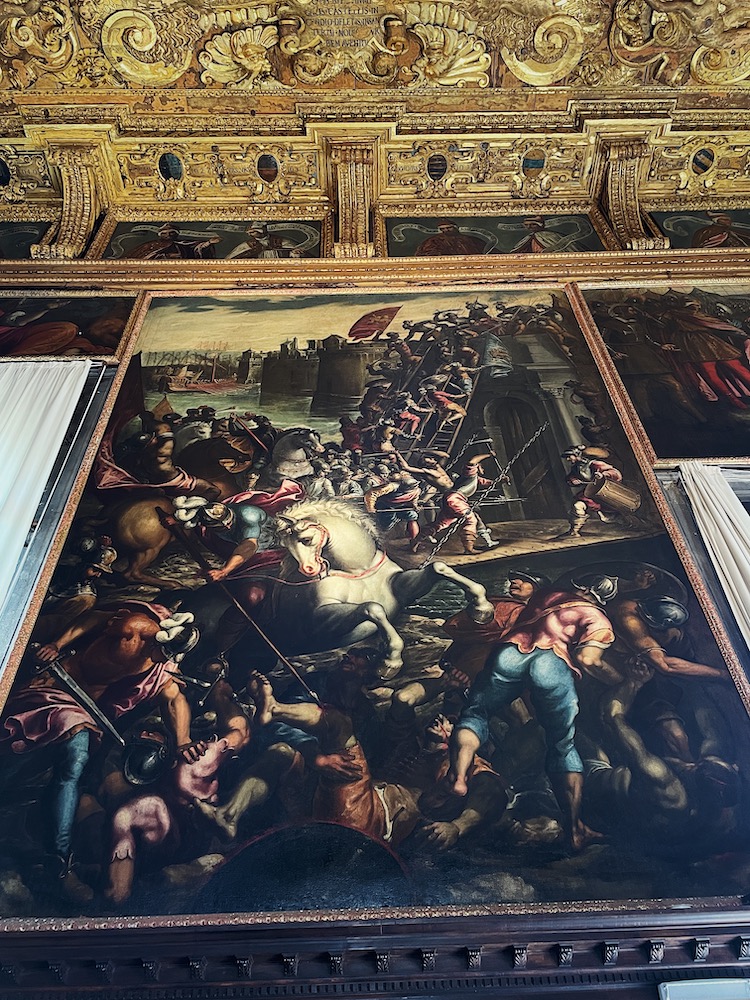
My favorite painting in this majestic room:
Crusaders Conquer the City of Zara in 1202, by Andrea Vicentino.
And then more rooms.
More ceilings.
More declarations that Venice was, obviously, magnificent.
The Sala dello Scrutinio
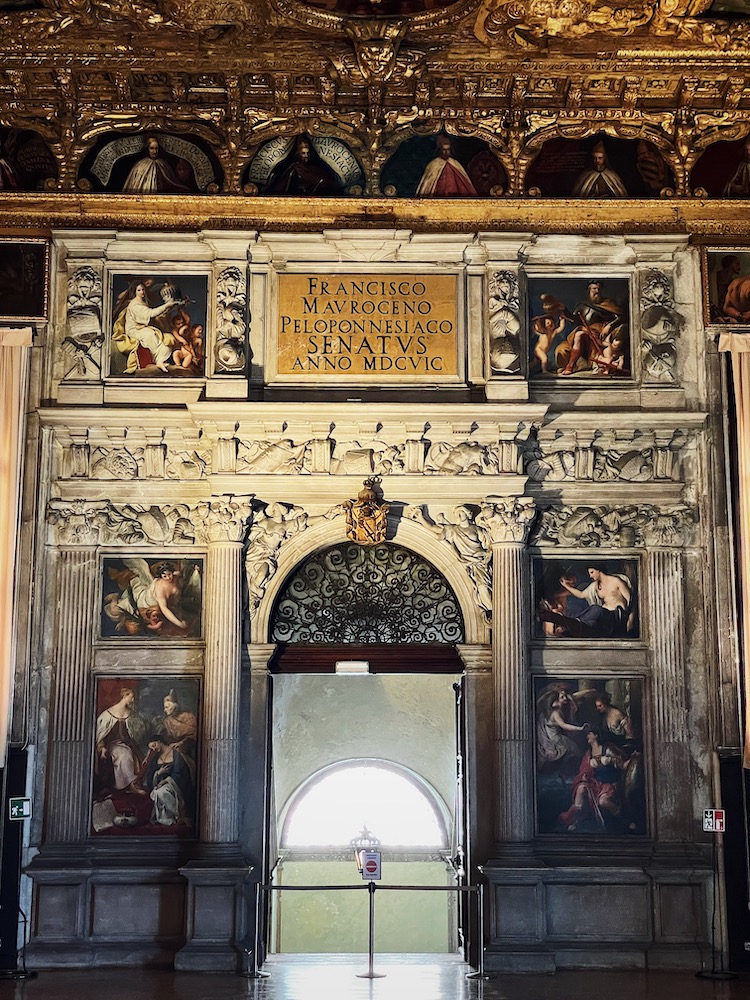
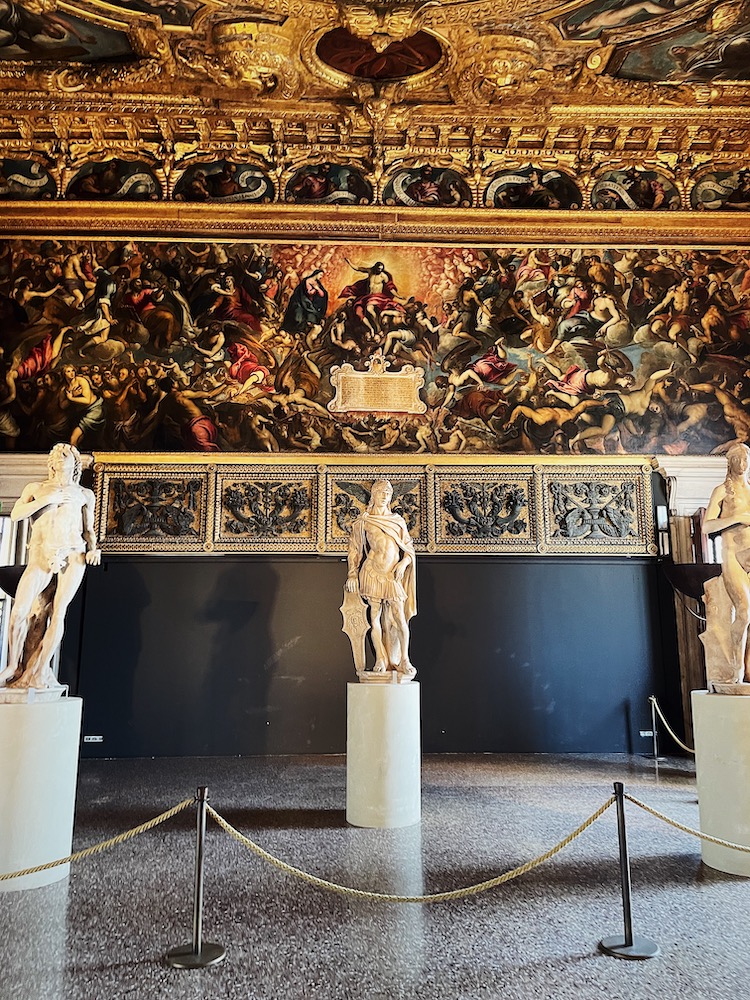
The Sala dello Scrutinio originally housed precious manuscripts donated to the Republic before becoming the room devoted primarily to electoral procedures.
After the fire of 1577, it was redecorated with scenes glorifying Venetian military history.
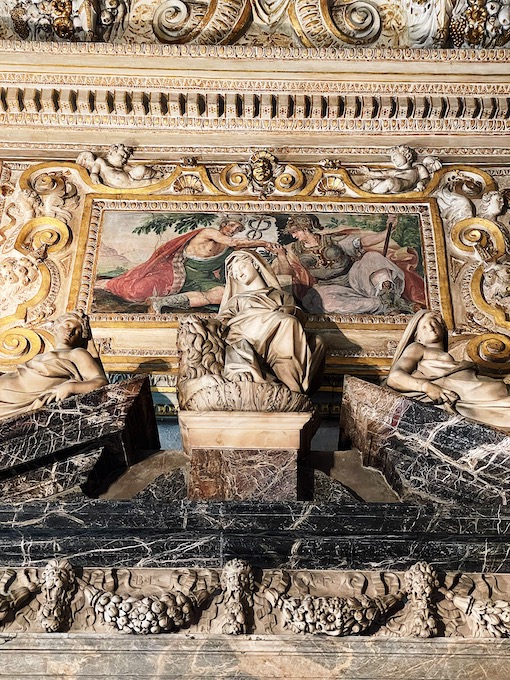
And at one end stands a triumphal arch by Andrea Tirali in honor of Doge Francesco Morosini, known as Il Peloponnesiaco, who died in 1694 during the war in Morea.
Nothing says “meeting room” quite like a triumphal arch.
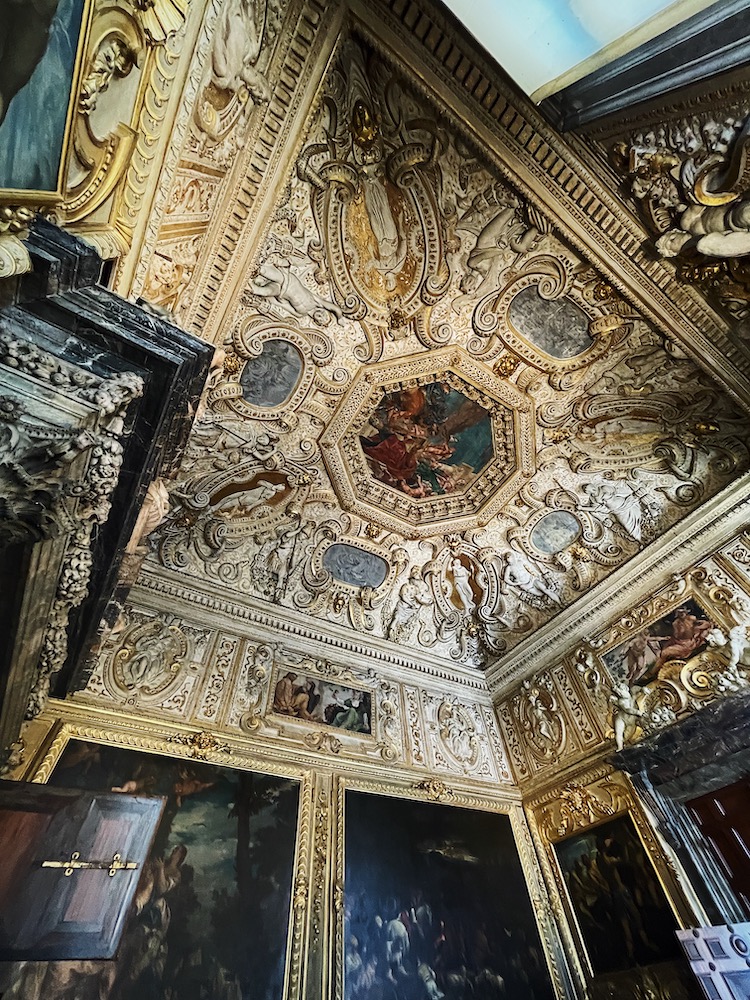
Wallpaper for the Room of My Dreams
And then there are the surfaces.
Walls.
Ceilings.
Leather.
Gold.
Marble.
The kind of decoration that makes you reconsider every sensible interior-design decision you’ve ever made.
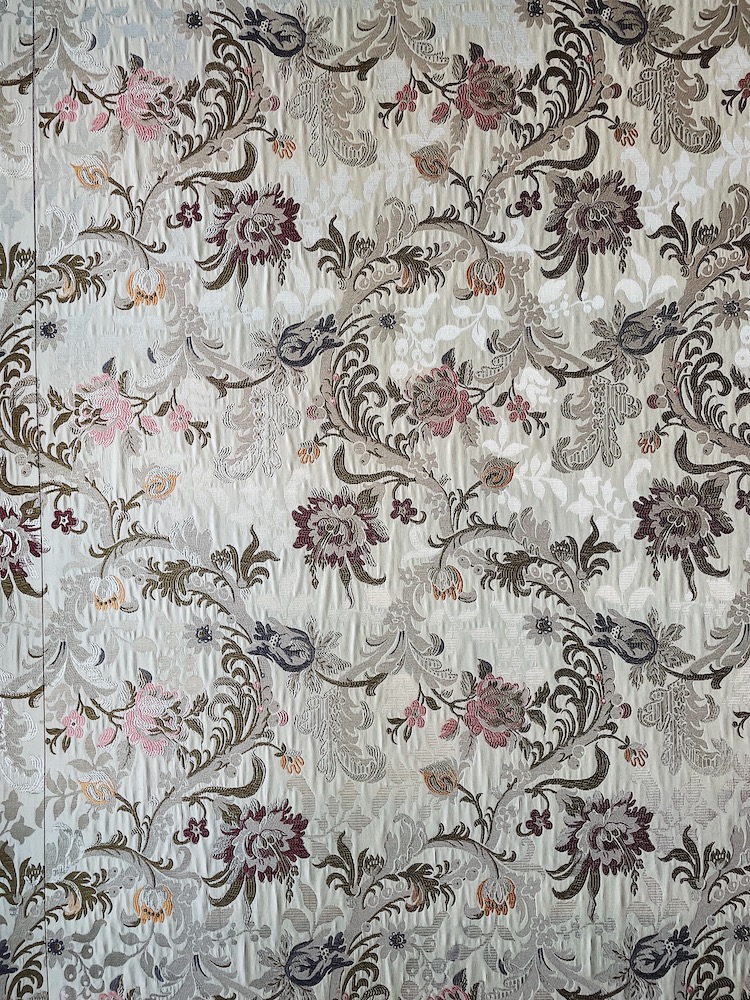
Wallpaper for the room of my dreams:
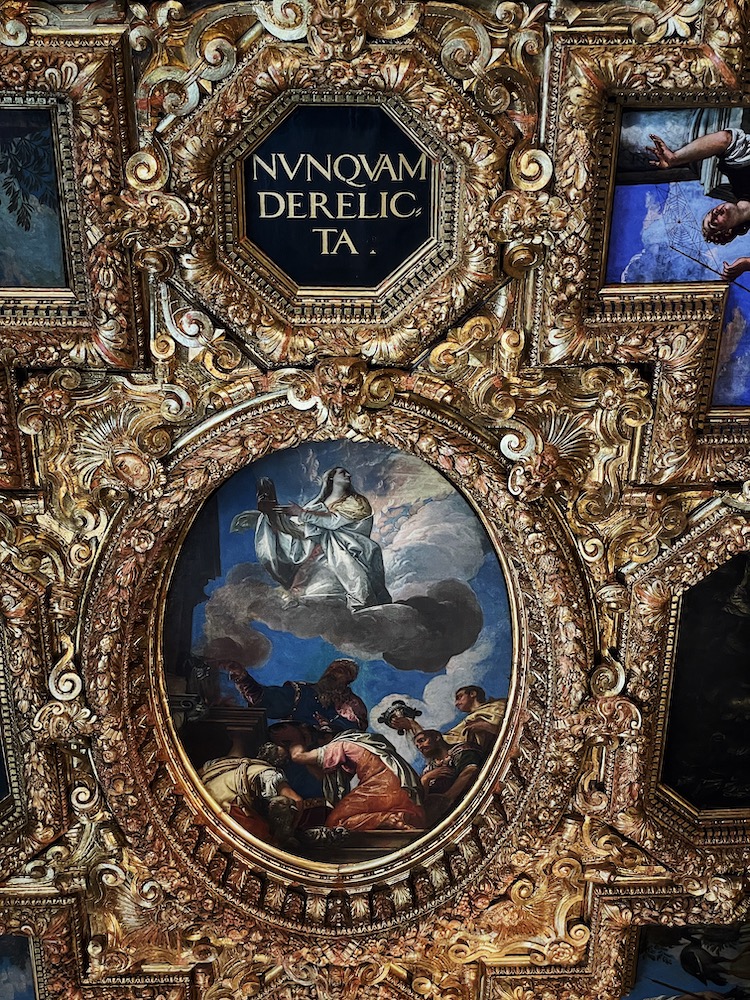
“NUNQUAM DERELICTA”
The Sala del Collegio takes political decoration to another level.
Its ceiling was painted by Paolo Veronese and celebrates the Buon Governo—the Good Government—of the Republic, together with the Faith on which it supposedly rested and the virtues guiding it.
Among the great central compositions is Faith and Religion, surrounded by the inscriptions:
NUNQUAM DERELICTA
and
REIPUBLICAE FUNDAMENTUM
Never abandoned.
The foundation of the Republic.
Nearby, another Veronese ceiling painting shows Mars and Neptune, accompanied by Robur Imperii: the strength of empire, evoking Venice’s power by land and sea.
You have to admire the confidence.
Just an Anteroom…
And sometimes, after a while, you begin to lose perspective.
You enter another spectacular space.
Gold everywhere.
Paintings.
Marble.
Monumental doors.
And discover:
just an anteroom.
The Anticollegio was indeed the formal waiting room where ambassadors and foreign delegations waited to be received by the Collegio, the body heavily involved in Venice’s foreign affairs.
Apparently Venetian bureaucracy had very high aesthetic standards.

Mars, Neptune, and the Scala dei Giganti
And Neptune appears again outside.
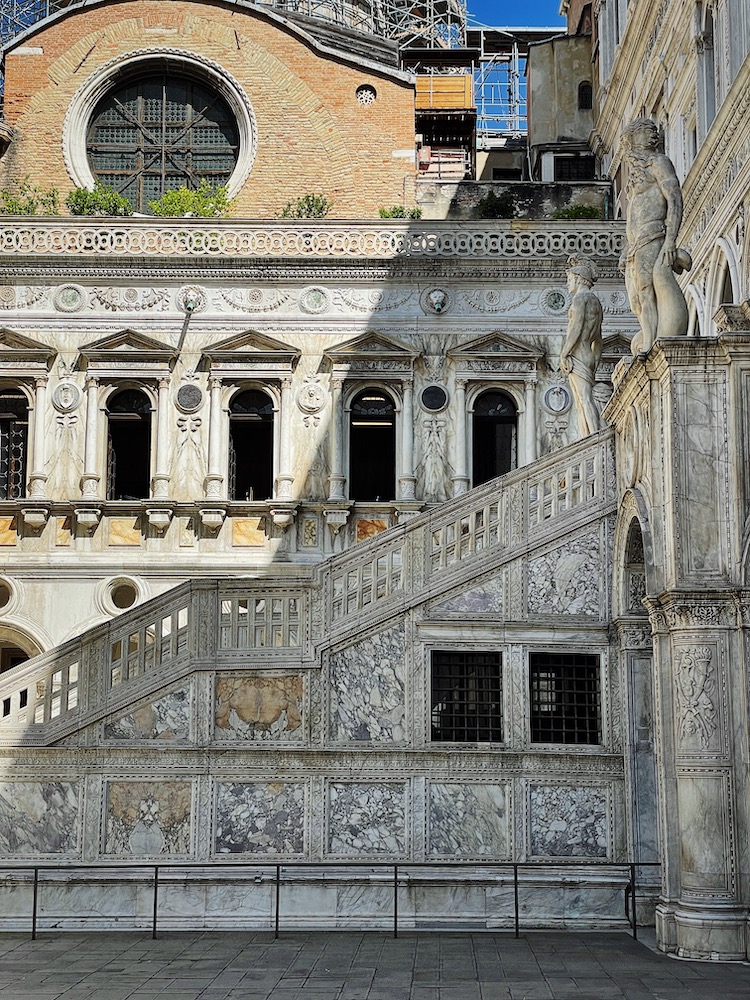
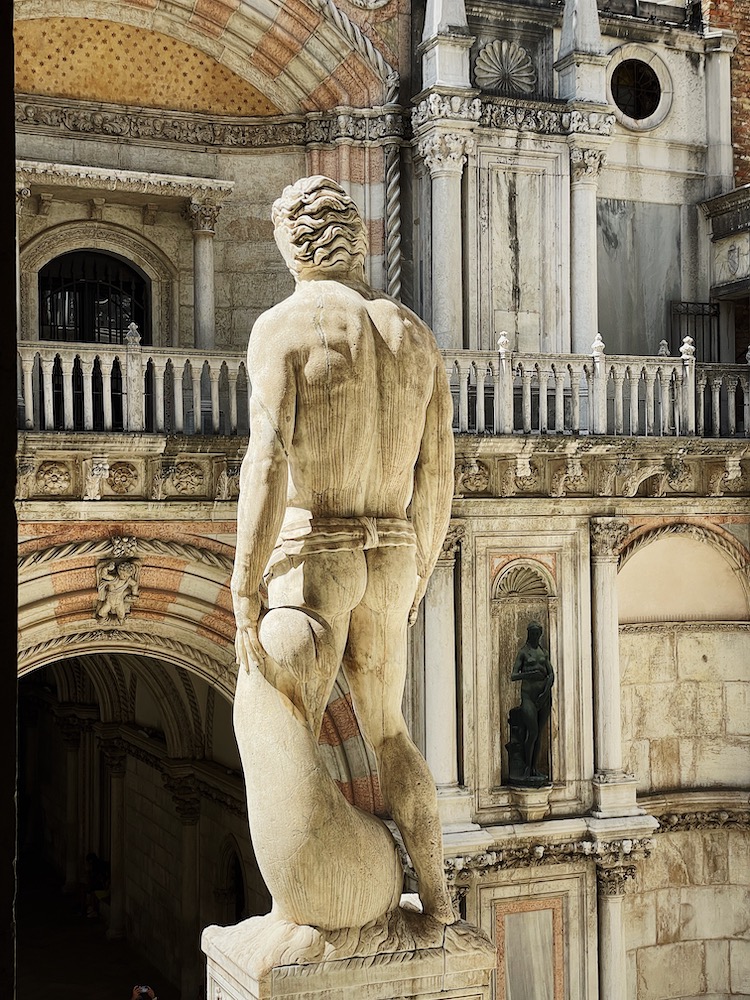
At the top of the Scala dei Giganti, the Giants’ Staircase, stand the colossal statues of Mars and Neptune, sculpted by Jacopo Sansovino in 1565.
War and sea.
Land and maritime power.
Exactly the message Venice wanted visitors to understand before they had even finished climbing the stairs.
The staircase itself was the Palace’s ancient ceremonial entrance and the place where the Doge was solemnly crowned.
You didn’t simply enter government in Venice.
You entered theatre. Not La Fenice, though.
The Bridge of Sighs
And finally, from power to punishment.
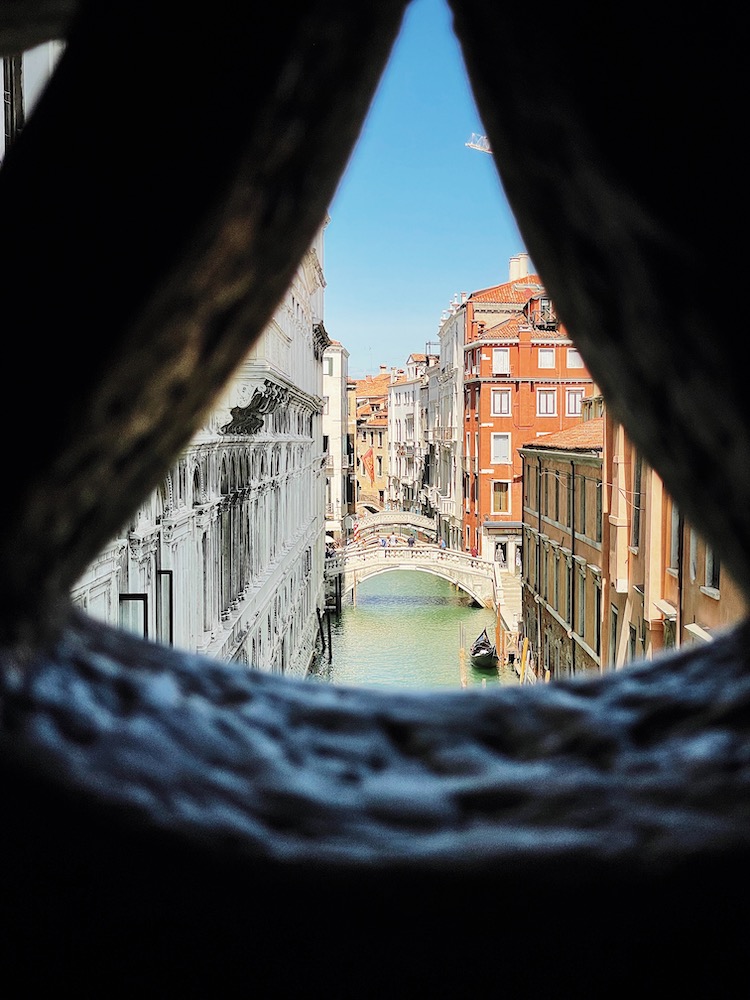
The Ponte dei Sospiri, the Bridge of Sighs, was completed in 1614 to connect the Doge’s Palace to the New Prisons, the separate prison building across the Rio di Palazzo.
The bridge is enclosed and divided into two narrow corridors.
Its famous name actually comes from the Romantic period, much later than the Republic itself: it evokes the imagined sighs of prisoners who, after leaving the courtroom and crossing toward their cells, caught a tiny glimpse of the lagoon and San Giorgio through the stone windows.
Freedom, just before losing it.
Casanova was indeed imprisoned inside the Doge’s Palace, but not in the New Prisons across the canal.
His cells were in the Piombi, the prison spaces built in the attic directly beneath the Palace’s lead-covered roof.
And, as we know, he eventually escaped.
Which, frankly, is a very Casanova detail anyway.
That’s it for today, amici belli.
Go get yourself a gelato or a granita to top your cultural day!
Baci,
Claudia
Want more of this Venice—the stories, food, rituals, history, and cultural details behind the city? Explore Venice Simposio, my cultural and culinary portrait of Venice.
