Buongiorno!
This post is a mini and incomplete guide to finding high-quality souvenirs in Rome – a challenge, I know, but not impossible!
When I travel, I often face the same dilemma: where to find authentic, meaningful souvenirs. I’m done with tacky, throwaway trinkets that gather dust. I’d rather spend my travel budget on fewer, well-made objects – something crafted locally, something that lasts. Because yes, less is more. That’s a lesson I learned after tossing yet another skimpy, useless object into the bin.
I’ve become a searcher of truth, of deeper meanings, of things that are worth my time and energy.
And if you are too, you already know how rare that is.
So I thought you, my dear Italophiles, deserved a proper guide to Rome’s best non-touristy souvenir shops – the ones I love, where you can find artisan-made Italian gifts that actually mean something.

What Makes a Souvenir High-Quality
For me – and maybe for you too – a souvenir worth the price, the luggage space, and the energy… must be authentic, beautiful, and truly made in Italy. These aren’t the only criteria for quality, of course, but they’re a good start.
Then comes the moment of connection: touching something velvety or silky, discovering an aesthetic you don’t see every day, imagining the face of a friend receiving an authentic Italian gift from your hands. A real souvenir stirs something.
And maybe you chat with the maker. Maybe you feel like you’re part of the same tribe – the ones who care. Maybe it leaves you with a story to tell. That’s the kind of experience we’re after. And, in different ways, the kind of thing I try to hold onto — and write about.
Where to Buy the Best Souvenirs in Rome
The places I list here are places I actually shop. So the list is short – but real. I hope you’ll enjoy the authenticity.
ARTISANAL SOUVENIRS & HOME GOODS
One day while wandering through the Prati neighborhood, I stumbled upon Gigli Laboratorio Orafo – Via degli Scipioni, 42. Its window was refreshingly unpretentious, and it featured bronze statuettes that immediately caught my eye — they reminded me of the Etruscan art I was researching at the time. Their style felt both familiar and unique, echoing ancient forms without being obvious copies. After chatting with the owner, I learned they’re made in Tarquinia, a town near Rome with deep Etruscan roots.
Alongside these pieces, you’ll find jewelry crafted with vintage stones and found objects, many of them truly one-of-a-kind. This is exactly the kind of artisanal souvenir from Rome that carries both history and heart.

GOURMET & EDIBLE SOUVENIRS FROM ROME
Looking for truffle oil, aged balsamic vinegar, artisanal pasta, or traditional Roman biscotti? Head to Castroni. It’s a Roman institution, and while there are several locations around the city, the flagship store – with its historic coffee roastery – is at Via Cola di Rienzo 196/198 in Prati.
Perfect for Italian food souvenirs that are both delicious and TSA-safe.
You might also want to stop by Babington’s Tea Room in Piazza di Spagna. Yes, it’s English — but it’s been beautifully Italianized over the decades. They offer seven signature tea blends dedicated to Rome, each one inspired by the city’s spirit. Elegant, gift-worthy, and surprisingly Roman.

JEWELRY & FASHION SOUVENIRS
Most of my jewelry comes from Sancesario – Via dei Coronari, 223 – a family-owned boutique crafting bijoux inspired by Renaissance jewelry. Handcrafted, bold, and beautiful.
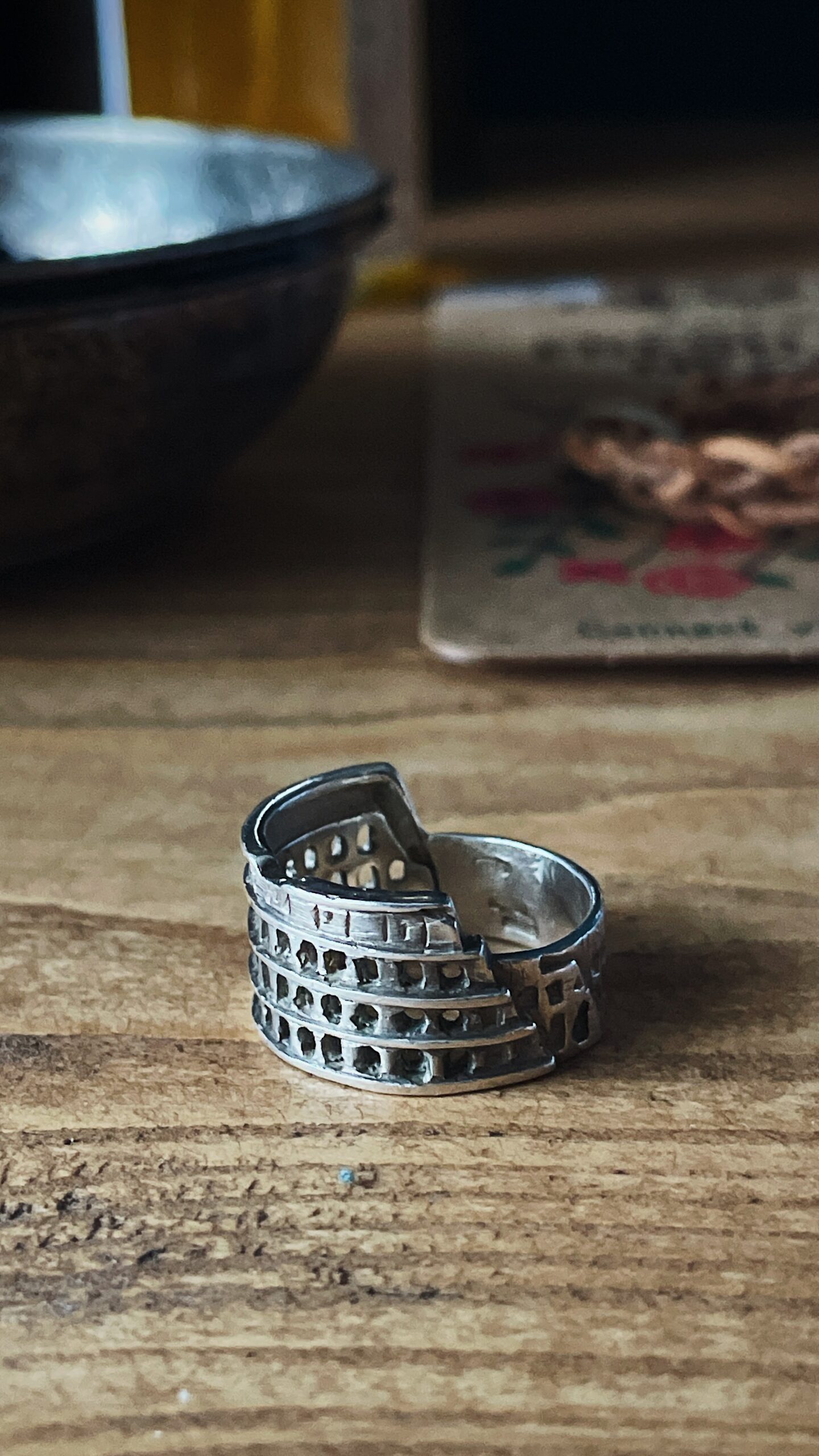
But my Colosseum-shaped ring (yes!) was made by Licciardello Gioielli – Via dei Serpenti, 5 – and it’s a piece I never take off.
Speaking of memory-laced places: I remember my mom dragging me into Battistoni – Via dei Condotti, 61/A – in search of the perfect tie for my dad. I’d pretend to help choose one, but she always had her own plan. What stayed with me most wasn’t the silk – it was the perfume.
Yes, Battistoni has its own historic fragrance, and it still lingers in the air of the boutique. Refined, unmistakable, and deeply Roman, it makes for a truly unique souvenir from the Eternal City.
And since we’re talking about scent…
Try PROFVMVM – Via Ripetta, 248 – a family-run perfume atelier in Rome with a cult following. Start with their fragrances inspired by the Eternal City herself.

Books & Paper Goods
A dear friend of mine manages some of Rome’s most beautiful museum bookshops, and she’s a rare kind of curator — the kind who scours the peninsula in search of local, handcrafted pieces with real soul. The result? Award-winning shops that are also treasure troves for high-quality paper goods and unique gifts.
You can stop by without a ticket at places like the Ara Pacis, Musei Capitolini, Museo di Roma, and the recently reopened Mausoleo di Augusto. And — humble moment — you’ll also find my postcards there, tucked among the handmade notebooks, prints, and illustrated books.
They’re little pieces of my Rome — inspired by what the city gives me, and made with care for those who want to carry a piece of it home.
If one gets married in Rome, the dream is to have the invitations printed by Pneider – Via del Leoncino, 25. Anything papery and of superior quality is their specialty.


Some of these places stay with you.
Others fade.
What remains — always — are the small rituals you carry back home.
Not Just Souvenirs, but Memories
As I always say, this is not Rome in the strictest – and often sterile – touristy way. This is my Rome. It’s inspiration, not commandment. A starting point, not a definitive list.
Because souvenirs, I believe, are memories you take home. They should reflect you, and the way you experienced the city. They don’t have to be perfect or precious. They can be the tackiest, made-elsewhere little something — as long as it reminds you of a special moment, a laugh, a feeling. That’s what gives it value.
It’s the human experience that counts. And as the neo-humanist I like to think I am, I beg you: make each one of your moments in Rome your moment. Own it. Fill it with something real.
What I can offer you are two Simposio books about Rome. One follows the traces of Rome’s myths. The other explores the society, rituals, and contradictions of Papal Rome.