
Some time ago, I spent a whole week in an Apulian trullo.
More specifically, in a group of trulli connected to form a living estate. A villa like the many you’ll see in Valle d’Itria, Puglia.
Luca’s nonna decided to rent one in Martina Franca to spend a week with the whole—or almost—family encapsulated in a separate dimension, where life flows slowly and easily.

What Is a Trullo?
Trulli are traditional dry-stone limestone constructions with thick walls and self-supporting conical roofs made of overlapping stone slabs, without mortar.
And then there is the famous story that, in the past, trulli could be quickly dismantled to evade taxes levied on permanent constructions. I have also read that the trick had less to do with actually pulling them down and more with their dry-stone construction: without mortar or cement, they could be presented as temporary rather than permanent buildings, and therefore escape taxation.
Our villa had nine trulli: each of our rooms was inside a trullo, each bathroom too, as were the kitchen, the laundry room, the storage room, and some other spaces not well identified.
The living room, together with the corridors, was the only more conventional structure.
The outside was beyond fabulous: a big patio, an orchard, and a swimming pool!

Mornings in a Trullo in Puglia
Our days began relatively early, having breakfast indoors or outdoors, depending on the heat.
Mostly with bocconotti, which, in Martina Franca, are stuffed with crema pasticcera and amarene—syrupy sour cherries.
Luca’s parents, who are not great advocates, nor could they ever be testimonials for Italian slow living, hurried to the nearby town for groceries or any excuse.
The rest of us lazed on the sunbeds until the heat was unbearable.

Then, the epopea of bathing began.
First, a toe.
A squeak.
“It’s so coooooold!”
Then the feet.
“Oh my, I must wait until I get used to it.”
Five minutes passed while chatting with the others, still lying down.
Then the calves.
Silently.
“Much better than I thought.”
So almost immediately came the legs.
More squeaks.
“Can’t wet the belly, the belly is the problem.”
More chatting.
At that point, there was only one way out.
The leap.
Plus the obvious shrieks and a resounding cry of relief.
No more chatting; swimming to warm up, the only purpose, at least for the first five minutes.
Consider this much more complicated for the ladies with their hair done and no intention of letting even a drop ruin it.
I know it sounds caricatural, but it is not.
Comic, yes, absolutely.
Reading Martina Franca in Martina Franca
If not swimming—or battling with pool noodles, or challenging each other in diving competitions—we spent the time reading.
I read Spatriati by the local writer Mario Desiati, which is almost entirely set in Martina Franca, and it was… divine.
The book is great, but being there—in the places described, near and with the people portrayed—was unforgettable.
I also feel the urge to tell you a joke from the book:
“Do you know why Jesus is Italian? He works for his dad’s firm. He thinks his mother is a virgin. And his mother thinks he’s a god.”
Lunch in Valle d’Itria
Some days we had an early aperitivo with beer and whatever comestible snacks we found around.
Other times, in an effort to stay clean and healthy, we had fresh fruit.
Also because the house was replenished with wine.
Luca’s dad decided to bring all the whites in his cellar, plus more, just in case.
I ate tons and tons of fioroni, the local figs, but I’m not sure this can make up for all that alcohol.
Nor did the only walk I took along the tratturo, lined with muretti a secco, another typical feature of the Valle d’Itria landscape: low walls made of masterfully embedded rocks.
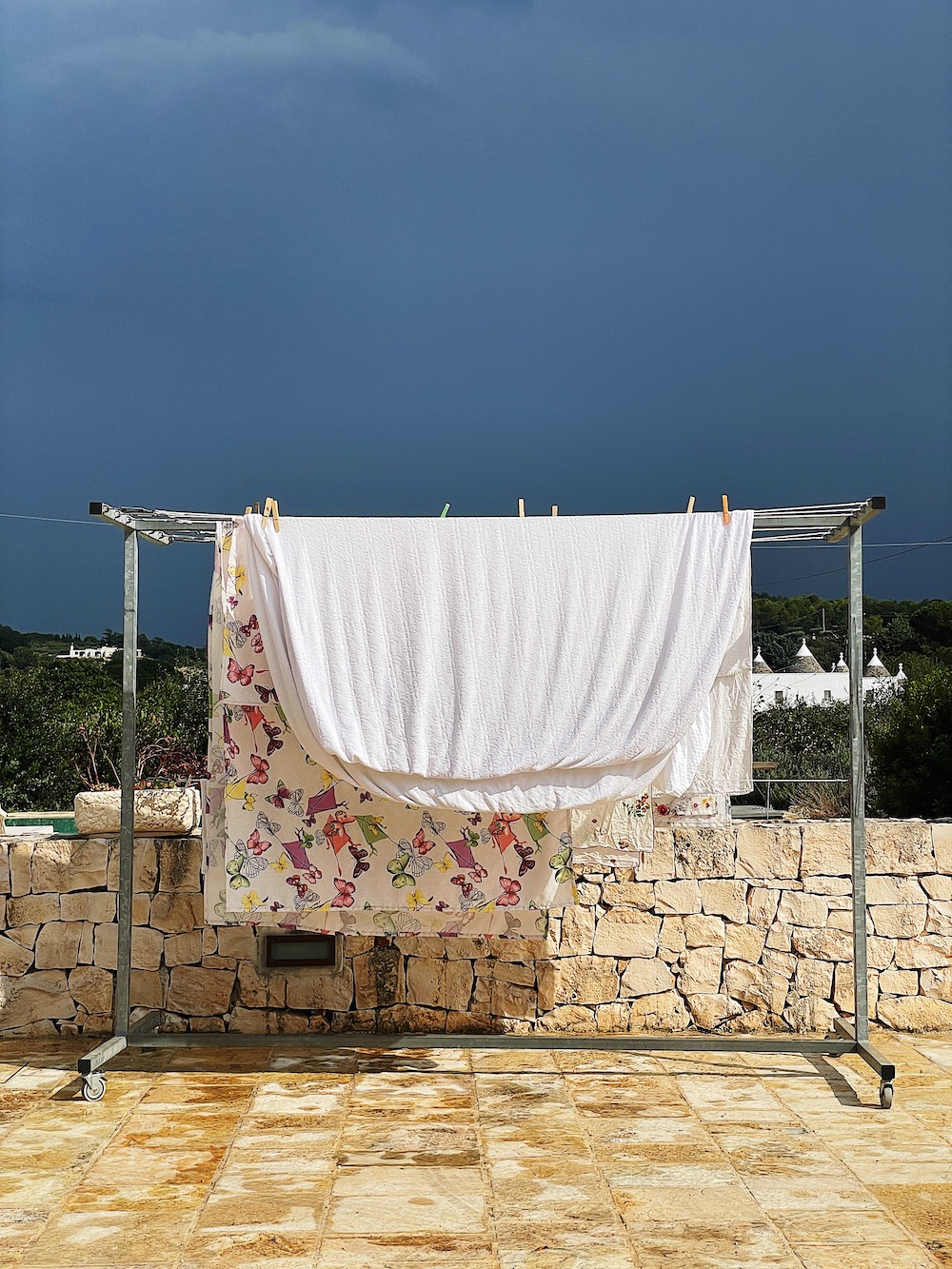
Before lunch, the more civilized among us—don’t look at me—changed their bathing suits and hung the wet ones out after, of course, rinsing them.
The meal was a rotation of properly cooked pasta dishes prepared by a volunteer and a triumph of local specialties: burrata, stracciatella, Capocollo di Martina Franca, smoked mozzarella, nodini…

Bread, wine, and fresh fruit ended the meal.
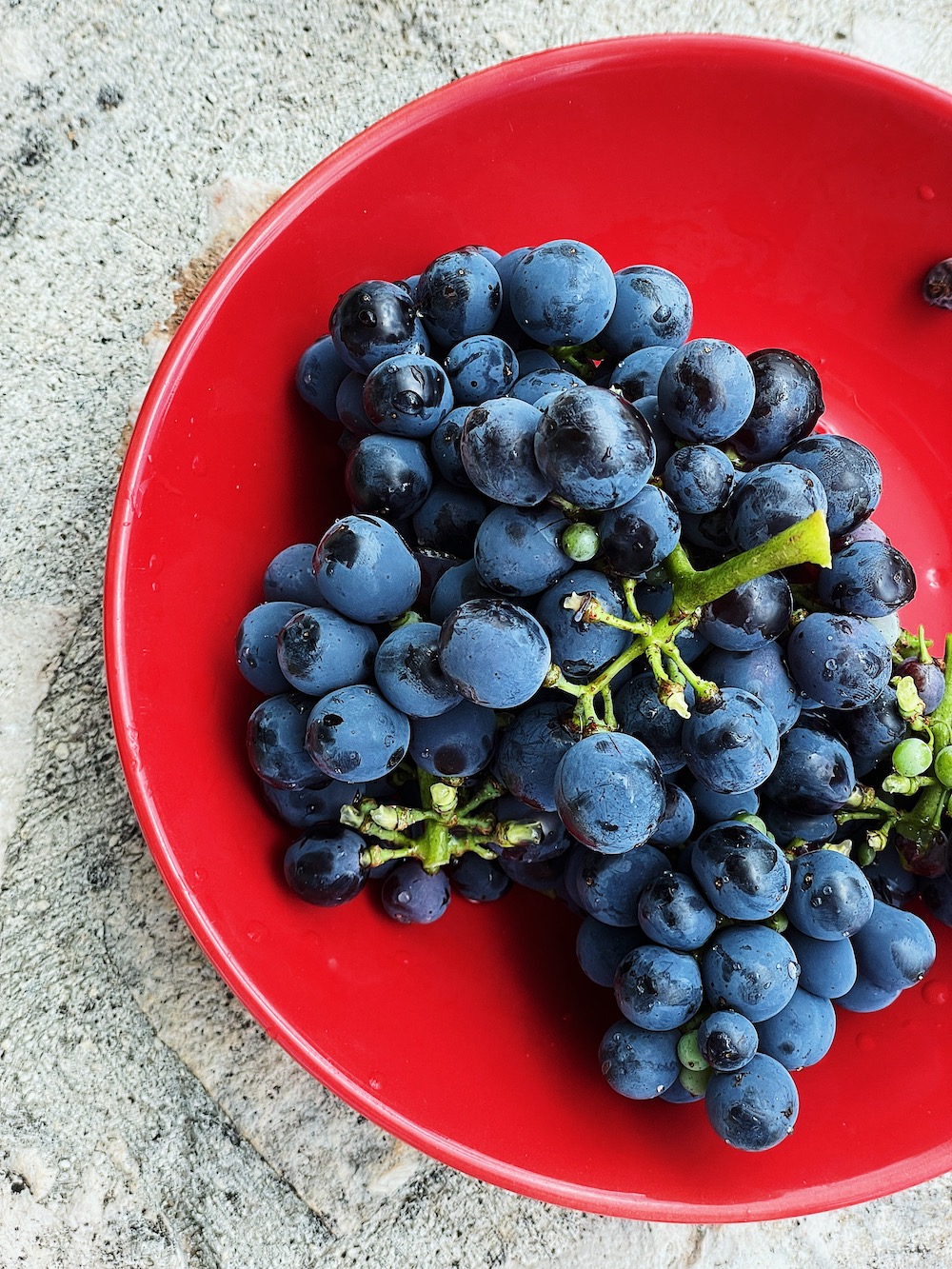
Including the grapes Luca’s dad stole from the nearby properties, making his wife infuriated.
This, at least, until the first birthday was celebrated and cake leftovers were added.
This family has a particular concentration of birthdays in August; I can count at least five, but I might be missing one or two.
In my family, the lucky month is May.
The Silent Hours
After lunch, to avoid the peak sun hours, we sheltered indoors.
Luca’s nonna watched her soaps.
Luca made fun of the characters, costumes, and stories for about five minutes, then fell asleep on the sofa.
The others read, watched sports on the PC, chatted, or played cards.
Scopa, of course, but also Sputo, revived from the sixties by Luca’s mother, who told us she and her friends always played and had tons of fun.
Sooner or later, I’ll write you down the rules, hopefully in time for the Christmas cartate: card-playing soirées.
The really silent hours were in the afternoon.
When each colonized a sunbed and the shadow of an umbrella to read, do crosswords, or sleep.
Then the first person stepped into the water and began the show of “should I bathe or should I not?”

Dinner, Wine, and a Little Escape
While someone, usually Luca’s mom, cooked dinner, the fellowship showered, dressed up a bit, picked flowers for the centerpiece, set the table, sliced bread, and uncorked wine.
One day we fired up the grill and feasted on bombette, fegatelli—liver rolls—sausages, and tagliata.
Another day Luca and I met our friend Sarah in Martina for dinner.
And another night, we all went to a fish restaurant for a banquet of raw fish and seafood and a giant grigliata mista—mixed grill.
Luca’s uncle is fond of whisky, so next to the tiny glasses of amari, the table was invariably scattered with not-so-tiny glasses of single malt.
I can’t tell you if my bed was comfortable or not: I fell into the deepest sleep after five minutes on the iPad.

I won’t lie to you: the cohabitation of many adults under one roof is challenging.
Italian families are challenging.
Obligations are there, imposed more than felt.
But the good weather, the good food (and wine!), the amazing places, and a couple of escapades help.
A lot.
If a little family chaos hasn’t scared you away and you’d like to spend more time in this part of Puglia with me—its food, landscapes, traditions and stories—you can continue the journey in my Simposio about Taranto, Puglia’s city of the two seas.
Enjoy every minute spent in Puglia!
Claudia
