
SOME THINGS ARE STILL BETTER MADE BY HAND
There is something deeply satisfying about making fresh pasta.
Flour.
Eggs.
A wooden board.
A rolling pin.
Nothing else.
Before machines, before shortcuts, this was how generations of Italians prepared Sunday lunch. And in many kitchens across Emilia-Romagna, they still do.
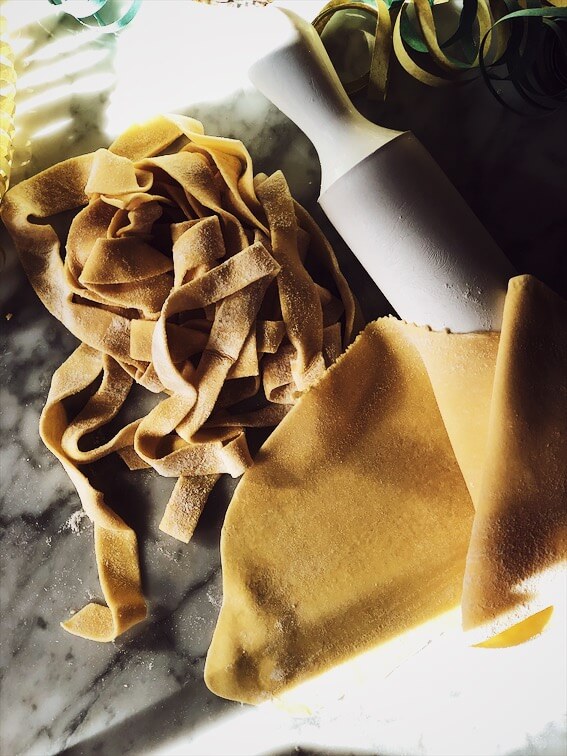
TWO INGREDIENTS ARE ENOUGH
Authentic tagliatelle require only two ingredients:
- eggs;
- 00 flour.
Nothing more.
Everything else depends on your hands.
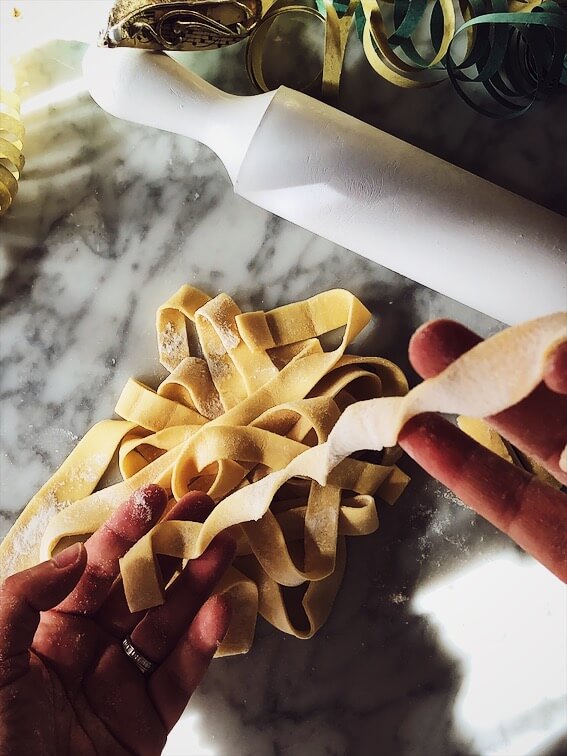
ROLLING PIN OR PASTA MACHINE?
Both work.
A pasta machine is faster and wonderfully practical.
But hand-rolled tagliatelle develop a slightly rough surface that captures ragù and other sauces more beautifully.
It’s one of those tiny details that makes homemade pasta feel different.
Not better because it’s traditional.
Better because the texture really changes.
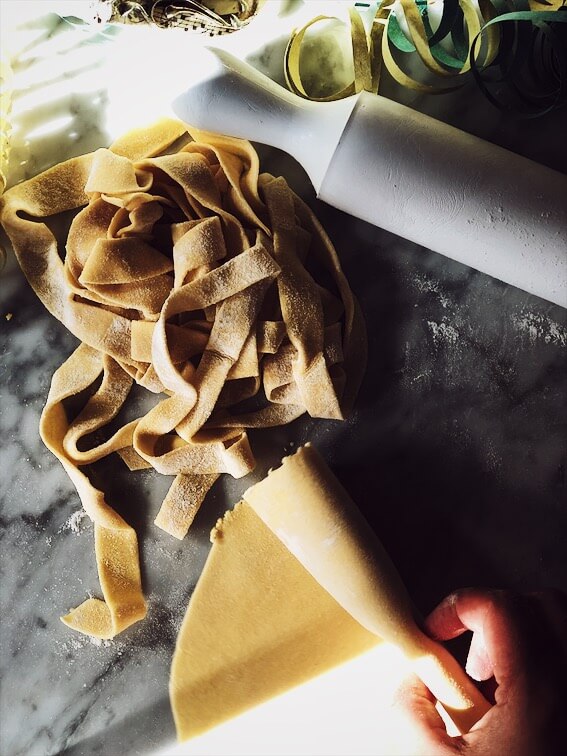
THE PASTA OF EMILIA-ROMAGNA
Although you’ll now find tagliatelle throughout Italy, they belong to Emilia-Romagna.
Especially Modena and Bologna.
They’re the natural companion to ragù, butter and sage, mushrooms, and countless slow-cooked sauces.
Making them from scratch is less difficult than it seems.
The first batch may be imperfect.
The second already starts looking Italian.
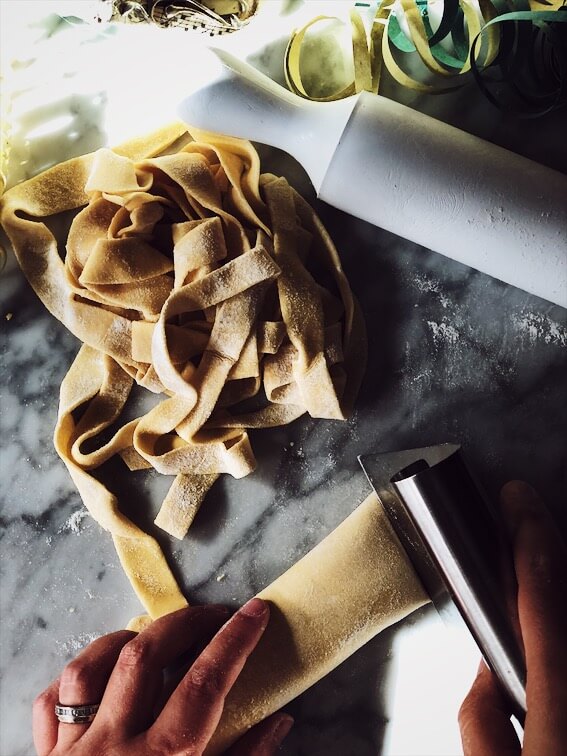
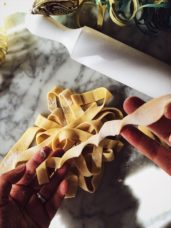
tagliatelle pasta
Homemade tagliatelle pasta with or without a pasta machine.
Ingredients
- 3.5 oz 00 flour 100 gr or 3/4 cup
- 1 egg
Instructions
kneading by hand
-
Place the flour on a working surface (for pasta, wood is better than marble!), make a hole in the middle with your fist and pour in the egg(s).
-
Mix the flour to incorporate the egg, starting with your fingertips and collecting the flour on the sides.
-
When the dough starts coming together, use your open hands to knead it by folding it over itself horizontally and pressing forward with the heel of your hand. You need an elastic dough, so this should take 15-20 minutes of hand kneading.
kneading with a mixer
-
If you are using a mixer, place ingredients in the bowl and use the kneading hook to work the dough for about 10 minutes. Anyway, working it a few minutes more with your hand (as described above) is a good idea ;-).
-
Place dough in a bowl and cover it with plastic, or lay it on the working surface and cover it with a bowl, upside down, for 20 minutes.
-
Divide the dough in 2 pieces (if you used 3/4 cup of flour, duplicate if more) and roll out each one using a rolling pin or a pasta machine and over a floured working surface.
rolling out by hand
-
If you are using the rolling pin, roll each piece as thin as possible. Every now and then sprinkle the dough, the roll and the surface with more flour, to make sure they don't stick together. You should form long irregular rectangles.
-
When you have rolled as much as you can, sprinkle both sides of the dough with flour and roll it up. Cut the roll into 1 cm (0.4 inch) coils.
-
Delicately unroll each coil and sprinkle with a little more flour to assure they don't stick together.
rolling out with a pasta machine
-
If you are using a pasta machine, flatten each piece of dough as much as you can with your hands and pass it through the wider setting. Repeat it once or twice. Lower the setting by one and feed the pasta through again. Repeat, lowering the setting until the penultimate (mine has 9 settings, I stop at 8).
-
If in any setting the pasta dough breaks or gets holes, simply fold it over itself and feed it through twice.If you get rectangles too long to handle, cut them in two and proceed to feed each piece separately.
-
Sprinkle each side of the stretches and roll them up to cut them as described above.
-
Your tagliatelle are ready. Cook them in boiling salted water (10gr or 1/2 tablespoon of salt per liter or 4 cups of water), until they float and then 2 (al dente)-4 minutes.
Recipe Notes
Refrigerate up to 2 days. If you want to save the pasta for a later use, I find freezing it is the best option. Make nests of single portions fettuccine and lay them on a tray, lined with parchment paper. Freeze 1/2-1 hour. Transfer nests to freezer-friendly plastic bags and freeze up to 3 months. You can cook frozen fettuccine in boiling water just like you do with fresh pasta, it will simply take it about a minute more to float!
FROM ITALIAN WINTER SIMPOSIO
This recipe first appeared in Italian Winter Simposio, where homemade pasta naturally belongs among slow Sundays, comforting meals, and the rituals that make winter tables feel warm.
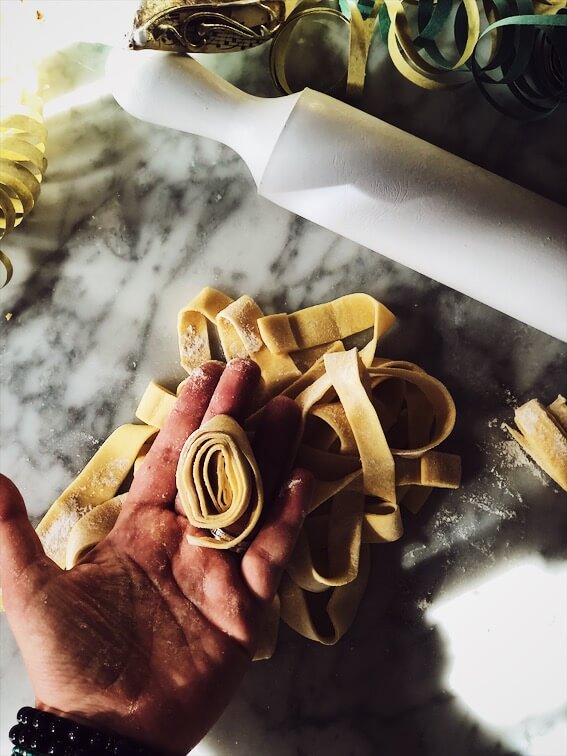
Enjoy your Tagliatelle pasta!
Claudia