
There are few things in Italian cuisine that make me happier than pesto.
I love the consistency, the easiness, the nutty flavor, the violent greenness of it. I love it on pasta, spread over toasted bread, or melting slowly over mozzarella on a hot summer table.
And yes, authentic Genovese pesto is traditionally made with a pestle and mortar.
You crush garlic and salt first, then pine nuts, then basil leaves, then cheese. Finally, olive oil arrives in a filo — slowly, continuously, patiently.
And you are absolutely welcome to do it that way.
But I use a blender.
And I suspect 95% of Italians do the same.
Maybe 99.
The flavor is practically identical, the effort is 1/1000, and modern life is already complicated enough.
This doesn’t mean that once every couple of years I don’t suddenly feel an ancestral need to pound, pound, pound, until green basil juice explodes from the leaves and the kitchen smells like Liguria.
But, as said, it happens rarely.
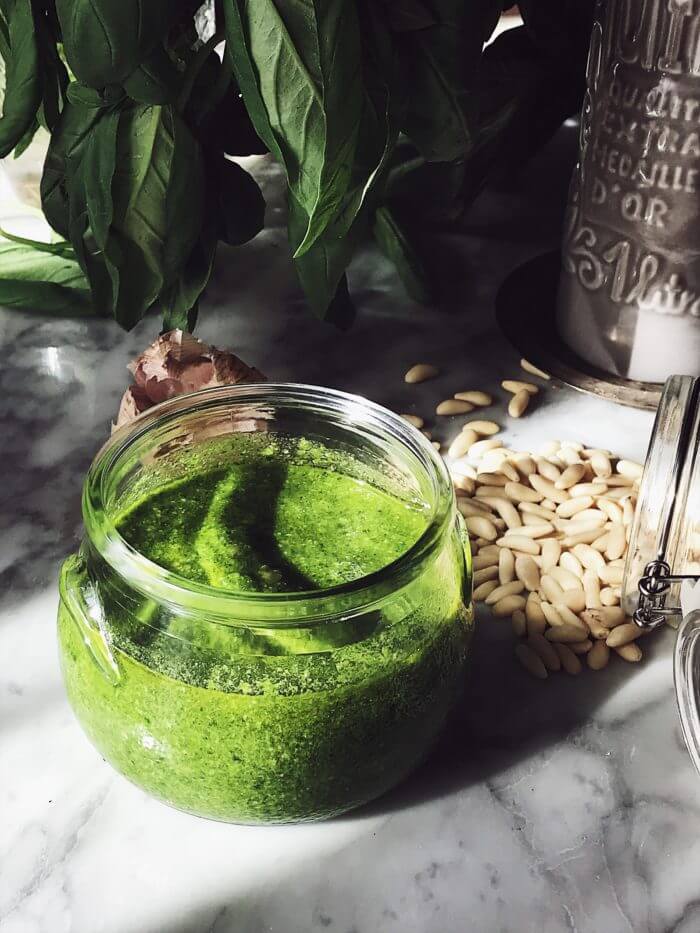
THE AUTHENTIC BASIL PESTO
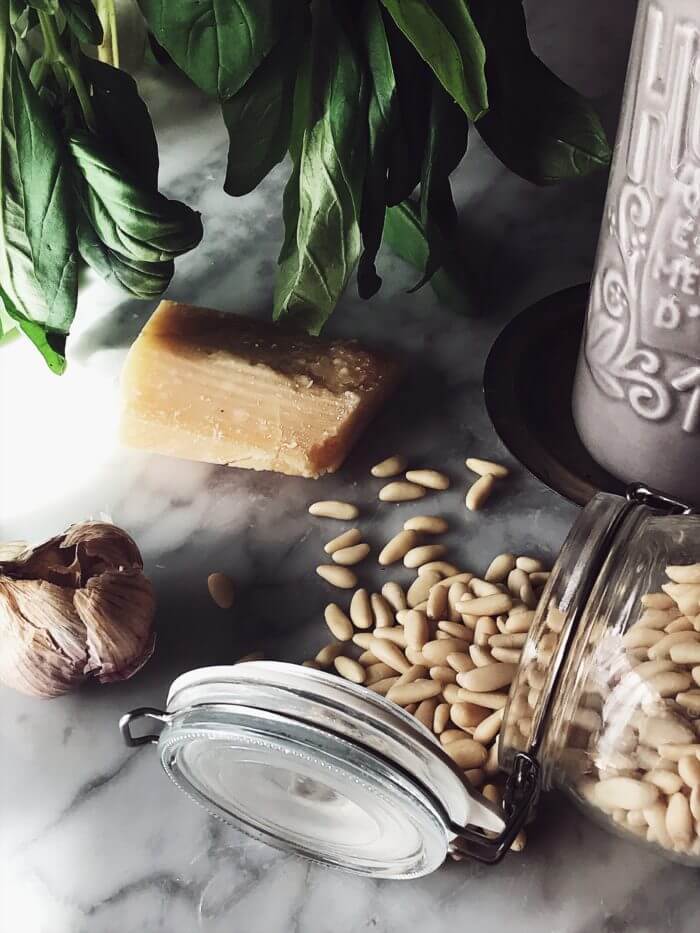
Traditional Genovese pesto is made with:
- fresh basil leaves
- olive oil
- pine nuts
- parmesan or pecorino cheese
- garlic
- salt
Other Italian regions have their own pesto versions, like the Sicilian Pesto Trapanese, while some modern variations skip dairy entirely.
But classic basil pesto remains one of Italy’s simplest and greatest sauces.
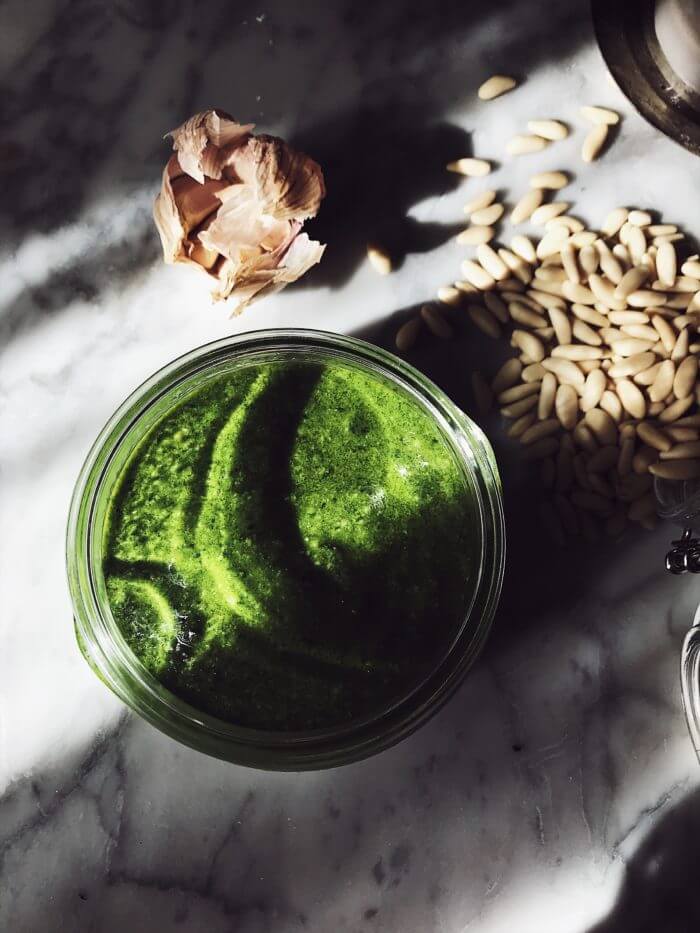
HOW TO MAKE TRADITIONAL BASIL PESTO
One tiny suggestion, especially if you are aesthetic enough to suffer when pesto darkens too quickly:
add two drops — really, just two — of freshly squeezed lemon juice before blending.
This trick was secretly shared with me by an old lady in Montalcino (I know, it should have happened during my research for the Cinque Terre Simposio, but that’s how life goes) while I was waiting for my husband and somehow ended up exchanging kitchen advice with her.
Which feels like a very Italian thing to happen.
authentic Italian basil pesto
Ingredients
- 2.8 oz big bunch of basil 80 gr
- 2.8 oz parmesan or pecorino cheese, or both, mixed in equal parts 80 gr
- 1 garlic clove
- 1 teaspoon coarse salt
- 2 tablespoons pine nuts 35 gr - 1.2 oz
- 4.4 oz extra-virgin olive oil 130 ml (Ligurian, if you find it)
Instructions
-
You can use a food processor or a hand blender. I prefer the second, so I can see what’s happening and I can stop as soon as I get the consistency I want. Which is not totally-creamy: I like to leave a few, very small, lumps. It gives the plate some kind of drama.
-
Place all the ingredients in a bowl/food processor and blend until you get the desired consistency.
-
Cook and season pasta (here, I used bucatini).
A FINAL NOTE ABOUT LEFTOVERS
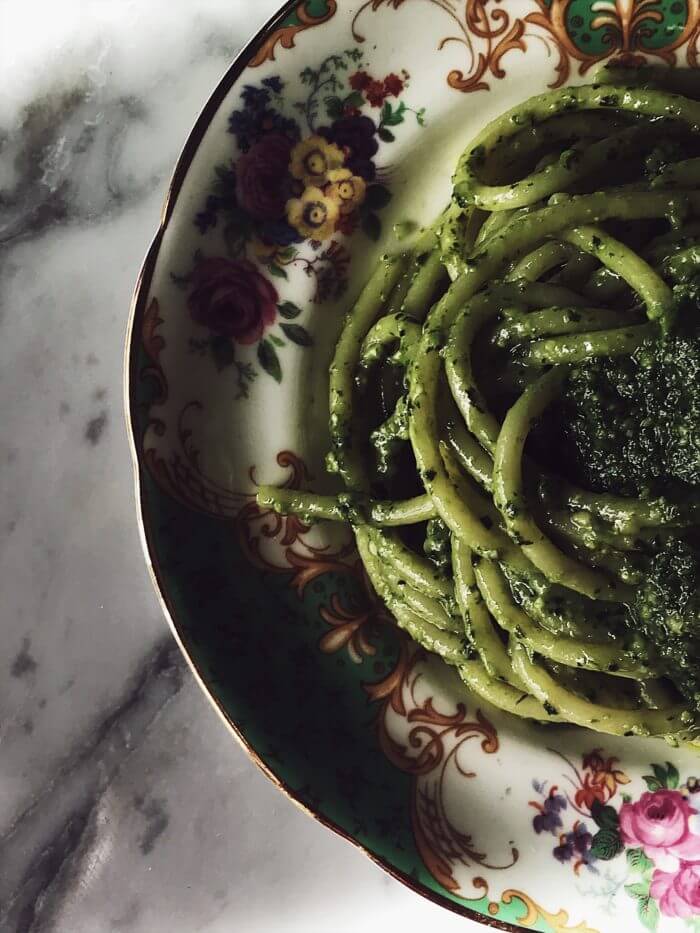
If — and I underline if — you somehow end up with leftover pesto pasta, add one or two eggs and turn it into a pasta frittata the next day.
Very Italian.
Very practical.
Very delicious.
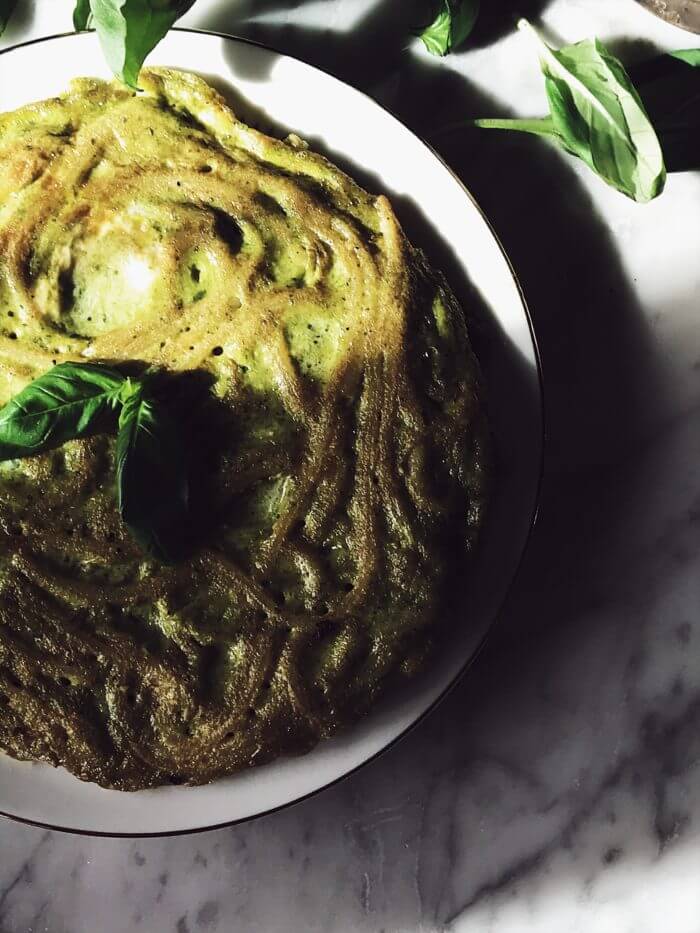
pesto pasta frittata
Ingredients
for each serving
- 1 cup basil pesto pasta
- 2 eggs
- salt and pepper
- extra-virgin Olive oil
Instructions
-
Mix eggs and leftover pasta. Add a pinch of salt and pepper.
-
Heat a teaspoon of olive oil in a small pan (or bigger if you are making multiple servings).
-
Pour in the pasta and cook, medium/low heat and lid on, 2-3 minutes, until the sides are dry.
-
Flip around and cook 2 more minutes.
-
Plate and serve!
Enjoy your basil pesto!
Claudia